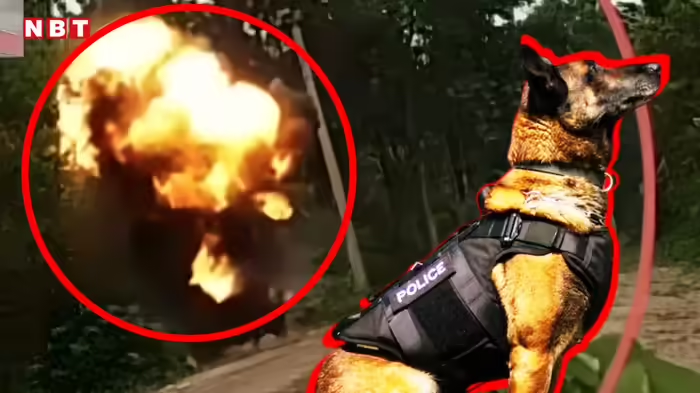

He was just three months old when he first arrived among uniformed personnel. He knew nothing of borders or explosives. Today, “Remo” (name changed) is one of the Indo-Tibetan Border Police’s (ITBP) elite combat dogs, trained to treat the detection of explosives like a game. His story reflects the journey of hundreds of military working dogs taught, through patience and play, to outsmart danger.
Nine Months to Build an Explosives Expert
According to his handler, Remo’s first deployment was in a Maoist-affected region of Chhattisgarh, where improvised explosive devices (IEDs) buried underground pose constant threats to security forces. “Remo cleared paths for us multiple times with his sharp sense of smell,” the handler said. It took nine months of intensive training to turn him into a skilled explosives detection dog.
“When he arrived at the training center at three months old, he was playful and mischievous,” the handler recalled. “There were moments of frustration, but these dogs learn through affection and reward—favorite food and toys. We sometimes spent 24 hours together during training. Over time, he became my most loyal partner.”
One Dog, One Handler
Dogs older than three months are not inducted into service. Training lasts between nine and eighteen months and is conducted in three phases. In the initial stage, dogs learn basic commands—sit, stand, walk, and respond to handler instructions—while building trust and coordination with a designated handler. Each dog is assigned a single handler responsible for its training and operational duties.
Handlers say changing personnel can disrupt a dog’s performance, as adapting to a new partner takes time. After basic training, dogs undergo behavioral and capability assessments to determine their specialization: explosives detection, narcotics detection, tracking criminals, or guard duty. Each dog is trained for only one specialization.
The Art of Silent Indication
In the final stage, dogs are conditioned to search with their noses close to the ground and are rewarded for identifying the correct scent. Explosive odors are gradually introduced into the exercises until detection becomes instinctive.
Crucially, ITBP dogs are trained in what is known as “silent indication.” If a dog barks near a sensitive explosive, the sound vibrations could trigger detonation. Instead, the dog is trained to quietly sit at a safe, predetermined distance upon detecting explosives. This silent posture alerts the handler to a possible threat without risking an explosion.
Through discipline, bonding, and play-based learning, these combat dogs become indispensable partners on the front lines—saving lives without making a sound.
Discover more from SD NEWS agency
Subscribe to get the latest posts sent to your email.