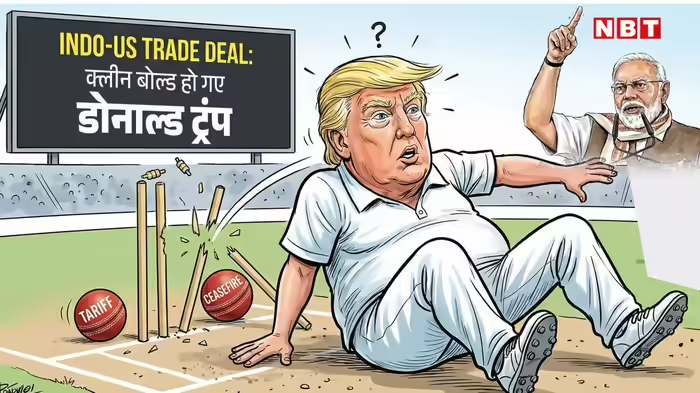

Over the past ten months, U.S. President Donald Trump had consistently strained relations with India. Yet, through meticulous groundwork by ministers, diplomats, lawmakers, and officials from both nations, Trump was ultimately compelled to agree to the Indo-US trade deal.
A Surprise Announcement That Shocked the World
Trump’s sudden phone call to Prime Minister Narendra Modi, announcing the reduction of tariffs to 18% and the trade agreement, took the global community by surprise. Since Operation Sindur, Trump had repeatedly expressed dissatisfaction with India, even while touting ceasefire initiatives between India and Pakistan. Despite imposing a 50% tariff, he continued lobbying with U.S. lawmakers, sometimes pushing for even higher tariffs. The question remains: was the trade deal a sudden development, or the result of long-standing negotiations and mutual understanding?
India and the U.S. Worked on a Future Roadmap
Trump’s approach toward India shifted after Operation Sindur. Believing that facilitating a ceasefire would earn him global acclaim—and potentially a Nobel Prize—he expected credit from India. When no acknowledgment was forthcoming, his frustration grew, straining bilateral ties. However, from May 2025 to February 2026, both nations worked under Trump’s administration to maintain relations and develop a forward-looking roadmap.
Meetings That Paved the Way
Despite Trump’s rhetoric, official meetings continued uninterrupted. The Quad Working Group played a significant role in maintaining dialogue. Multiple U.S. lawmakers visited India to support bilateral ties, while Indian officials ensured diplomatic engagement remained strong. Foreign Minister S. Jaishankar, Foreign Secretary Vikram Misri, and Deputy NSA Pavan Kapoor conducted visits to the U.S., while Indian Ambassador to Washington Vinay Mohan Kwatra maintained interactions with U.S. officials. Last month, IT Minister Ashwini Vaishnaw traveled to Washington to participate in a major initiative on critical minerals.
The Role of U.S. Ambassador Sergio Gore
India-US relations began improving more rapidly after Sergio Gore assumed charge as the new U.S. Ambassador to India. His direct access to the White House eased coordination. Soon after his arrival in New Delhi, U.S. lawmakers, ministers, and officials began visiting India in quick succession. Just before the trade deal announcement, a bipartisan delegation led by Armed Services Committee Chair Michael Rogers visited India. Ranking Member Adam Smith also engaged with Indian officials and business leaders.
Diplomats, Ministers, and Lawmakers Laid the Groundwork
During these visits, U.S. delegations held discussions with Foreign Minister S. Jaishankar, Defence Secretary Rajesh Kumar Singh, senior officials, and Indian business leaders. Their objective was clear: to establish a robust foundation for finalizing the trade deal. Michael Rogers emphasized that “America views India as a major defence partner,” while Adam Smith highlighted that defence cooperation benefits both nations’ regional stability and economic and national security interests.
How Trump Got “Clean Bowled”
In addition, last month, U.S. Senator Steve Daines, a member of the Senate Foreign Relations Committee, visited India. He met Foreign Minister Jaishankar, Commerce and Industry Minister Piyush Goyal, Indian lawmakers, and business leaders. On January 25, U.S. Army Secretary Daniel Driscoll also met with Chief of Defence Staff General Upendra Dwivedi. Essentially, the Indo-US trade deal announced by Trump is the culmination of groundwork laid by his own ministers and officials. Their careful diplomacy rendered his previous narratives on tariffs and ceasefire largely irrelevant.
Discover more from SD NEWS agency
Subscribe to get the latest posts sent to your email.