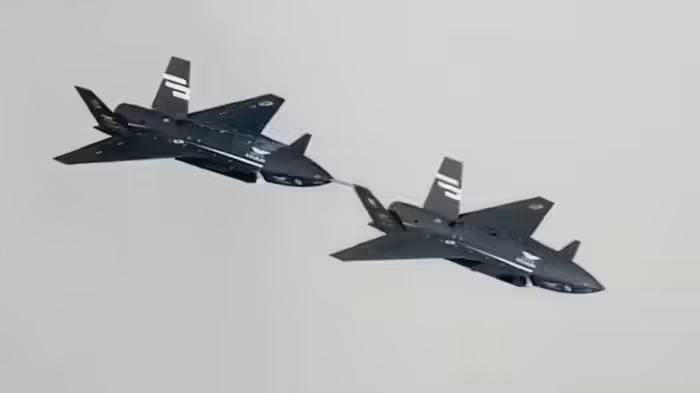
In a landmark achievement in artificial intelligence and military aviation, Turkey has become the first country in the world to successfully conduct a fully autonomous close-formation flight using two armed drones—without any human intervention.
The breakthrough was achieved using Turkey’s indigenous Kizilelma unmanned combat aerial vehicles (UCAVs), marking a major technological milestone that even global powers such as the United States, China, and Russia have not yet demonstrated.
Historic Autonomous Formation Flight
According to a report by Interesting Engineering, the two jet-powered Kizilelma drones completed the close-formation flight on December 28 within Turkish airspace. The drones took off, coordinated their movements, maintained precise formation, and returned safely—entirely on their own.
Close-formation flying is considered highly complex, even for piloted aircraft, as it requires constant coordination to avoid mid-air collisions. Achieving this autonomously represents a significant leap in AI-driven aviation.
AI and Onboard Sensors Enable Real-Time Coordination
During the flight, the drones relied on artificial intelligence algorithms and onboard sensor systems to continuously exchange real-time data with each other. This enabled them to maintain speed, distance, and alignment while flying at high velocities.
Experts note that this was particularly challenging because no human operator was actively controlling the drones. Instead, AI-managed flight-control systems ensured accurate synchronization throughout the mission.
Developed by Turkish Defense Firm Baykar
The Kizilelma drones were developed by Baykar, one of Turkey’s leading defense technology companies. The drones are capable of both manned and unmanned operations and can be equipped with weapons, making them suitable for advanced combat missions.
With this success, Turkey has positioned itself at the forefront of AI-powered autonomous combat aviation.
Future of Drone Swarm Warfare
Reports suggest that modifications were made to the drones’ flight management algorithms to enable this mission. In the future, the same technology could allow multiple drones to fly as coordinated swarms, sharing information autonomously and executing complex operations with minimal human oversight.
Such systems could significantly reduce manpower requirements while enhancing operational efficiency, situational awareness, and battlefield effectiveness.
A Major Shift in Global Defense Technology
Turkey’s achievement underscores the growing role of artificial intelligence in modern warfare. As autonomous systems become more capable, this development could reshape military strategies worldwide and accelerate the global race for AI-driven defense technologies.
Discover more from SD NEWS agency
Subscribe to get the latest posts sent to your email.