
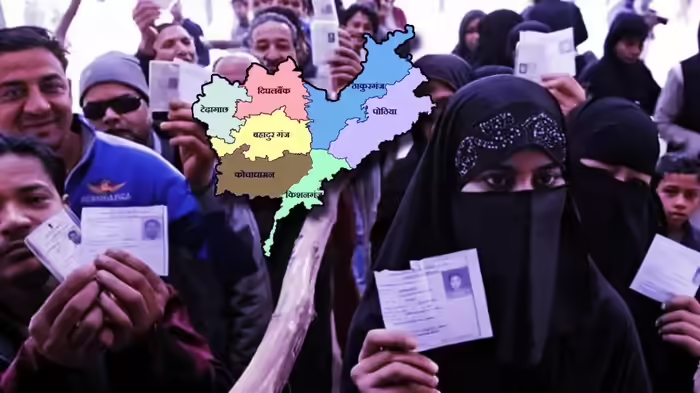

Patna: Bihar’s Kishanganj district is unique in the state for its striking demographic imbalance. With a Muslim population of around 70%, Hindus are now a minority, making it the only district in Bihar with such a composition. This demographic shift has shaped the political landscape of the district for decades.
A History of Hindu Representation
Before 1969, Kishanganj had elected Hindu representatives without any issue of communal polarization. The first MLA of Kishanganj, Rawatmal Agrawal, won the 1952 election defeating independent candidate Abdul Hayat. In 1967, Sushila Kapoor of the Praja Socialist Party defeated independent K. Rahman by over 11,000 votes, receiving 16,207 votes to Rahman’s 4,594. This reflected a time when voter preference was based on leadership rather than religion.
The Shift from 1969 Onwards
The 1969 mid-term elections marked a turning point. Sushila Kapoor contested again from Praja Socialist Party, facing Congress candidate Rafiq Alam. Despite anti-Congress sentiment across Bihar due to its role in toppling three coalition governments, Rafiq Alam received a staggering 17,999 votes, while Sushila Kapoor managed only 8,322—a dramatic reversal within just two years. Since then, no Hindu candidate has been elected MLA or MP from Kishanganj. Even parties like BJP have had to field Muslim candidates, such as Shah Nawaz Hussain, to secure victories.
1967: A Landmark Year
The 1967 Lok Sabha elections further illustrate this demographic shift. Lakhan Lal Kapoor of the Praja Socialist Party defeated Congress’ Mohammad Tahir by around 34,000 votes. His wife, Sushila Kapoor, was the last Hindu MLA of Kishanganj, making the district unique in having a husband-wife duo winning the parliamentary and assembly seats simultaneously. Lakhan Lal Kapoor remains the last Hindu MP from Kishanganj.
Lakhan Lal Kapoor: Revolutionary and Socialist Leader
Born in Munger, Kapoor settled in Kishanganj around 1942. During India’s independence struggle, he was an active revolutionary in Kishanganj, Purnia, and the West Bengal border areas, and even participated in Nepalese movements. After independence, he joined the Socialist Party, later becoming a member of the Praja Socialist Party after party splits.
He first became MLA from Bahadurganj in 1957, defeating Congress’ Mohammad Ahsan by 2,596 votes, receiving 11,873 votes. Kapoor had deep roots in Kishanganj and remained committed to representing the district. In 1977, when the Janata Party was formed, he contested from Purnia on JP’s recommendation, winning the Lok Sabha seat, while Halimuddin Ahmed contested from Kishanganj.
A District Shaped by Demographics
Kishanganj today serves as a vivid example of how demographic changes influence electoral politics. The district’s Muslim-majority population has not only shaped candidate selection but has also ensured that Hindu representation at both the state and national levels has remained absent for over five decades.
Discover more from SD NEWS agency
Subscribe to get the latest posts sent to your email.