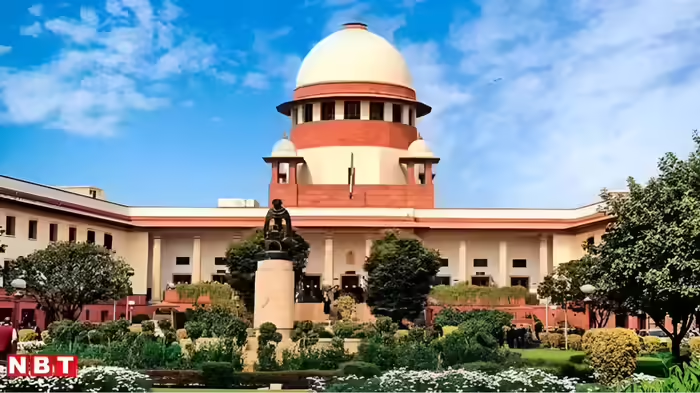
The Supreme Court of India has withdrawn its 20 November ruling on the new definition of the Aravalli Hills and proposed the formation of a high-level expert committee to reassess the matter. The earlier decision had accepted a definition provided by a central government committee under the Ministry of Environment, Forest, and Climate Change in October 2025, aimed at protecting one of the world’s oldest mountain ranges.
Need for Re-evaluation
The Court emphasized the need to examine whether the new definition creates structural inconsistencies and inadvertently expands “non-Aravalli” areas, potentially enabling unregulated mining and environmental degradation.
High-Level Committee Proposed
Chief Justice D.Y. Chandrachud suggested forming a committee to identify areas that could be excluded from the Aravalli classification and to ensure that such exclusions do not compromise environmental stability. The Attorney General of India, R. Venkataramani, and senior advocate P.S. Parameswar have been requested to assist the Court, particularly in advising on the committee’s composition. Notices have also been issued to states, directing that no mining activity should occur pending further review.
Five Key Issues Under Review
The Supreme Court outlined five critical questions for expert analysis:
- Structural Consistency: Does limiting the definition to areas spanning 500 meters between two or more hills create structural inconsistencies that reduce the protected area’s geographic extent?
- Impact on Non-Aravalli Areas: Has this restricted demarcation inadvertently increased the scope of non-Aravalli areas, allowing unregulated mining or other disruptive activities?
- Ecological Connectivity: Do hills over 100 meters in height, located more than 500 meters apart, still function collectively as a single ecological system, maintaining forests, wildlife corridors, water flows, and environmental balance?
- Regulated Mining Possibilities: Can regulated mining be permitted in these connected hills, and what spatial criteria should define the Aravalli range to safeguard ecological integrity?
- Scientific Verification: Given that only 1,048 of 12,081 hills in Rajasthan exceed 100 meters, should smaller hills be considered for protection? Are the claims about height scientifically accurate, and do they ensure ecological continuity?
Opposition to the New Definition
Environmentalists have argued that the new definition, if strictly applied, could exclude over 90% of the hills, opening the door to indiscriminate mining and real estate development. According to the 2010 Forest Survey of India report, only 8% of the approximately 12,000 hills exceed 100 meters. The Ministry of Environment has already revised the Aravalli district list, removing several districts from the protected range.
Committee Mandate
The proposed committee will:
- Identify areas falling within the new Aravalli definition.
- Examine which areas can be excluded from protection under the proposed criteria.
- Assess whether regulated mining or monitoring could still negatively impact the ecological balance.
- Evaluate the risk to areas excluded from the definition and its impact on overall ecological integrity.
- Review both short-term and long-term environmental consequences of implementing the proposed definition and related guidelines.
Committee Recommendations
The committee has recommended including all hilltops over 100 meters in height. If two or more such hills are within 500 meters of each other, they will collectively be designated as part of the Aravalli range. This definition will also encompass surrounding landforms, ensuring that no elevated landform in Aravalli districts is excluded, regardless of slope.
The Supreme Court is expected to make a final determination after receiving the committee’s detailed analysis, balancing environmental protection with developmental considerations.
Discover more from SD NEWS agency
Subscribe to get the latest posts sent to your email.