
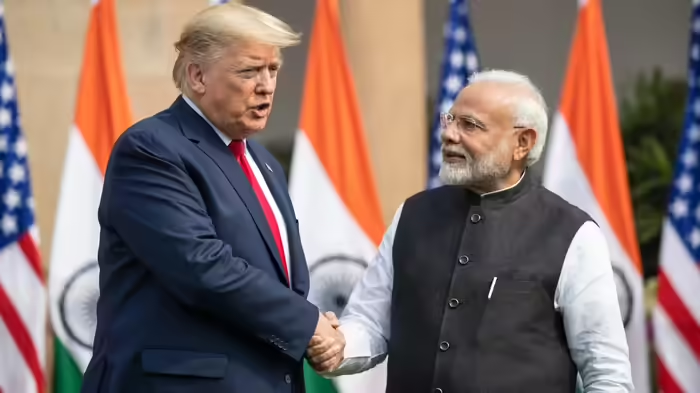

New Delhi, February 23, 2026:The proposed India–United States trade agreement may be nearing conclusion, but rapidly shifting global trade dynamics suggest that New Delhi must proceed with calculated caution before putting its final stamp on the deal.

A recent ruling by the U.S. Supreme Court striking down former global tariffs imposed by U.S. President Donald Trump brought temporary relief to exporters worldwide. However, the relief proved short-lived. Within hours of the verdict, Trump invoked alternative legal provisions to reintroduce tariffs, underlining the continued unpredictability of American trade policy.
Swift Policy Reversals Shake Global Confidence
Earlier, Trump had imposed sweeping tariffs using the International Emergency Economic Powers Act. After the Supreme Court deemed those measures unlawful, he turned to Section 122 of the Trade Act of 1974 — a rarely used provision that grants the U.S. President authority to impose tariffs of up to 15 percent for 150 days without congressional approval.
Initially announcing a flat 10 percent tariff, the administration revised it to 15 percent within 24 hours. The rapid policy shifts have unsettled global markets and raised fresh concerns about the stability of U.S. trade commitments.
While the Supreme Court’s intervention was viewed as a strong institutional check, Trump’s public criticism of the judiciary has sparked debate within the United States about executive overreach and the health of democratic norms. Observers believe further unexpected measures cannot be ruled out.
Implications for India
For India, the developments come at a sensitive juncture. A recent understanding between New Delhi and Washington had brought down tariff levels from 50 percent to 18 percent under the proposed Free Trade Agreement framework. Although the new 15 percent tariff appears comparatively lower, it now applies broadly across countries, potentially narrowing India’s relative advantage.
Prime Minister Narendra Modi and his administration are closely assessing the evolving situation. President Trump has stated that the India deal will not be adversely affected, but the agreement is yet to receive its final approval.
Given the fluid policy environment in Washington, experts argue that India must factor in changing legal and political realities while negotiating the final contours of the deal. With tariff policies shifting within hours and alternative legal avenues being explored by the White House, prudence and strategic foresight will be essential.
As global trade enters another phase of uncertainty, the India–US partnership remains important — but sealing the deal will require careful calibration in light of evolving circumstances.
Discover more from SD NEWS agency
Subscribe to get the latest posts sent to your email.
