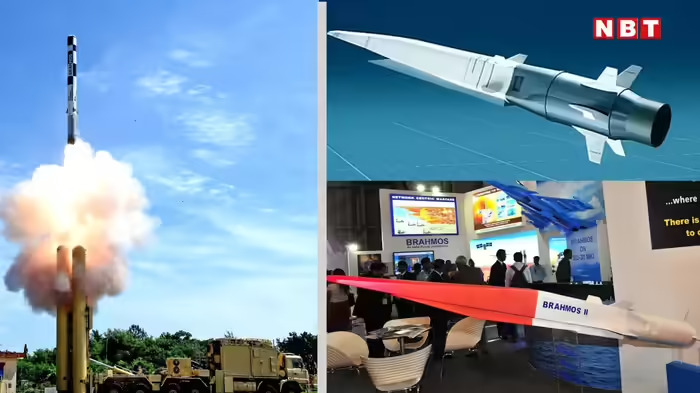
New Delhi: India has accelerated the development of the BrahMos-II missile, a hyper-sonic cruise missile jointly developed with Russia. The current BrahMos missile has already proven its precision and effectiveness during Operation Sindur against Pakistan. The upcoming BrahMos-II promises to be even faster, deadlier, and virtually impossible for adversaries like China and Pakistan to intercept, at least for the next decade.
Unmatched Speed and Range
The BrahMos-II is expected to achieve speeds of over Mach 7 (around 8,500 km/h), significantly faster than its predecessor. Current BrahMos missiles travel at Mach 2.8 to Mach 3, flying at low altitudes near sea level, which makes detection by enemy radars extremely difficult. The new version will incorporate advanced internal navigation combined with satellite guidance. Its range will be extended from the existing 290 km to 450 km and eventually 900 km, enhancing India’s strategic strike capability.
Multi-Domain Launch Capability
The BrahMos-II will be capable of being launched from land, sea, air, and even submarines. Officials say that even with upgrades to enemy radars, sensors, and space-based tracking systems, intercepting this missile in the next decade will remain highly improbable.
Hyper-Sonic Variant on the Horizon
India is fast-tracking the BrahMos-II’s hyper-sonic variant, which will feature glide capabilities and unparalleled speed, potentially reaching Mach 7 and beyond. The first test flight is expected around 2028. Experts believe that this will make it nearly impossible for any defense network to track or neutralize the missile.
Operational Excellence Confirmed
During Operation Sindur, the Indian Air Force successfully used the BrahMos missile against Pakistan. Launched from Su-30MKI fighter jets, the missile demonstrated exceptional accuracy and strike capability, bypassing Pakistan’s advanced air defense systems supplied by China.
Low-Altitude Advantage
Defense experts highlight that low-altitude, high-speed cruise missiles like the BrahMos are extremely difficult to track and intercept—a fact underscored during the Russia-Ukraine conflict, where the P-800 Oniks (BrahMos’ technological predecessor) proved nearly impossible to neutralize, despite the presence of advanced US and European air defense systems in Ukraine.
A Strategic Edge for the 2030s
With both supersonic and hyper-sonic variants under development, analysts predict that the BrahMos-II will continue to provide India’s armed forces with a formidable strategic edge well into the 2030s.
Discover more from SD NEWS agency
Subscribe to get the latest posts sent to your email.