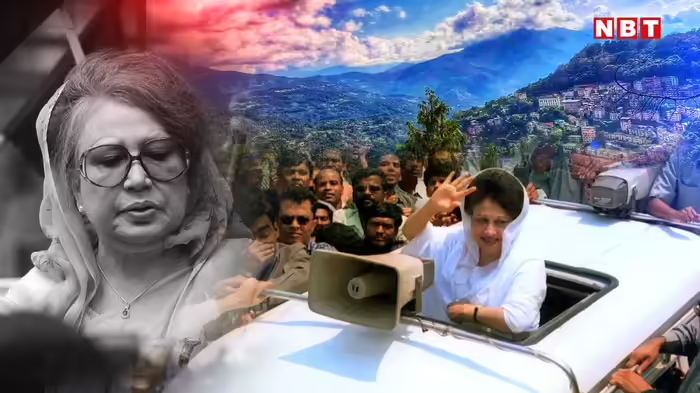
Khaleda Zia, the former Prime Minister of Bangladesh and long-time leader of the Bangladesh Nationalist Party (BNP), passed away early Tuesday at the age of 80 after a prolonged illness. Despite her birth in India’s Jalpaiguri district in 1945, her political career was marked by a notably critical stance toward India.
Early Life and Family Background
Born in undivided India, Zia’s early years were shaped by the Partition of 1947, which split Jalpaiguri into the Indian state of West Bengal, while her family moved to East Pakistan (now Bangladesh). In 1960, she married Ziaur Rahman, a Pakistani Army officer who later rebelled against the Pakistani forces during the 1971 Bangladesh Liberation War and eventually became President of Bangladesh in 1977, founding the BNP in 1978.
Rise in Politics
Following the assassination of Ziaur Rahman on 30 May 1981, the BNP faced a leadership crisis. Senior party leaders urged Khaleda Zia to assume leadership. She was appointed Vice-Chairperson in January 1984 and became Party Chairperson the same year. Zia retained her position across party councils in 1993, 2009, and 2016, remaining BNP’s leader for over four decades. She first became Bangladesh’s first female Prime Minister in 1991 and returned for a second term after the 1996 elections.
Tense Relations with India
Zia’s terms as Prime Minister coincided with some of the most challenging periods in India-Bangladesh relations. She adopted a cautious and often adversarial approach toward New Delhi, shaping bilateral relations for more than a decade.
Reasons Behind Her India-Critical Policies
Zia opposed initiatives to enhance road connectivity and transit rights for India through Bangladesh, arguing that such agreements would compromise Bangladesh’s sovereignty and security. She famously criticized Indian trucks’ movement through Bangladesh without tolls as akin to “slavery.”
Her opposition extended to diplomatic agreements, including resisting the renewal of the 1972 India-Bangladesh Friendship Treaty, which strategic experts considered crucial for regional security. Zia positioned the BNP as the guardian of Bangladesh’s national interests, framing her policies as a defense against perceived Indian dominance.
Despite her birth on Indian soil, Khaleda Zia’s political narrative consistently emphasized Bangladesh’s independence and self-interest, often putting her at odds with India during her political tenure.
Discover more from SD NEWS agency
Subscribe to get the latest posts sent to your email.