Wednesday, July 22

Business & Economy

DDA TOD Housing Scheme Sees Poor Response, Only 178 Flats Sold
Business & Economy

DDA TOD Housing Scheme Sees Poor Response, Only 178 Flats Sold

New Delhi: The Delhi Development Authority’s (DDA) Transit-Oriented Development (TOD) housing scheme has failed to attract buyers, with less than 20% of the flats sold in its first phase. Out of 1,026 2BHK flats offered under the Kadkarduma project, only 178 were successfully auctioned. The DDA is now preparing to issue demand-cum-allotment letters to the successful applicants. The TOD scheme aims to reduce congestion in Delhi by promoting residential development along major transit corridors. The flats in the first phase were priced between ₹1.78 crore and ₹3.08 crore, with sizes ranging from 141.64 sq. meters for the smallest unit to 250.32 sq. meters for the largest. The allotment letters will be sent to successful applicants through the DDA housing portal at eservices.dda.org.in. ...

EV Buyers in Delhi May Get Parking Benefits, Says Parliamentary Committee
Business & Economy

EV Buyers in Delhi May Get Parking Benefits, Says Parliamentary Committee

Incentives Beyond SubsidiesThe Parliamentary Standing Committee of the Ministry of Environment has suggested additional incentives for electric vehicle (EV) buyers in Delhi, beyond the existing subsidies. The recommendations aim to promote EV adoption and curb rising air pollution in the national capital. Key Recommendations Parking Benefits: EV owners could receive reduced or free parking fees, while petrol and diesel vehicles may face higher parking charges. Registration & Loans: Annual registration limits could be set for new non-electric vehicles. Private banks could launch green car loans, with interest rates linked to the vehicle’s fuel type. Fitness Test Adjustment: The first fitness test for private vehicles could be conducted at 10 years instead of 15, with specia...
India-New Zealand Free Trade Deal: Who Gains, Who Loses? Explained in Simple Terms
Business & Economy

India-New Zealand Free Trade Deal: Who Gains, Who Loses? Explained in Simple Terms

Deal FinalizedIndia and New Zealand have successfully concluded negotiations on a Free Trade Agreement (FTA). Under this pact, Indian goods will enter New Zealand duty-free, opening significant opportunities for sectors like textiles and leather, which rely heavily on labor. Additionally, New Zealand has committed to investing $20 billion (over ₹1.6 lakh crore) in India over the next 15 years. Benefits for IndiaNew Zealand will provide zero-duty access for 100% of Indian exports, helping Indian companies expand their presence there. However, India has chosen not to reduce import duties on sectors like dairy, meat, vegetables, sugar, copper, and aluminum. Benefits for New ZealandExports from New Zealand, including sheep meat, wool, coal, and timber, will enjoy duty-free access to Indi...
Mutual Fund Fees Revamp: GST, SEBI Charges to Be Billed Separately – What Investors Stand to Gain
Business & Economy

Mutual Fund Fees Revamp: GST, SEBI Charges to Be Billed Separately – What Investors Stand to Gain

New Framework for Mutual Fund ExpensesThe Securities and Exchange Board of India (SEBI) has announced a significant change in the way mutual fund expenses are calculated. Effective from 17 December, the expense ratio framework has been revised to give investors a clearer picture of the actual costs they incur. According to reports from The Economic Times, the traditional expense ratio will now be referred to as the Base Expense Ratio (BER). SEBI has clarified that certain taxes and charges will no longer be included in this limit. These include Securities Transaction Tax (STT), Commodity Transaction Tax (CTT), GST, stamp duty, SEBI fees, and exchange charges. These will now be billed separately based on actual expenses. The Total Expense Ratio (TER) will now be calculated as: BER + brok...
Success Story: From a Garage Workshop to a ₹10,752 Crore Empire – How Shrikant Badve’s Star Rose
Business & Economy

Success Story: From a Garage Workshop to a ₹10,752 Crore Empire – How Shrikant Badve’s Star Rose

The story of Shrikant Badve began in 1988, when he and a few associates started a small workshop in Pune called Badve Engineering. At the time, the venture had just three employees and very limited resources. Yet, Badve had a big dream. From Humble BeginningsShrikant Badve, the founder and Managing Director of Belrise Industries, has now entered the list of India’s billionaires. From a modest garage-like unit, he built a nationwide automotive component powerhouse. Today, his company employs over 8,000 skilled professionals and operates more than 17 modern manufacturing plants across India. Building a Multi-Thousand Crore TurnoverA graduate in Electronics and Telecommunications from Babasaheb Ambedkar Marathwada University, Badve also received management training at IIM Ahmedabad, sha...
Stocks to Watch: Jupiter Wagons, Cochin Shipyard Lead Gains as Market Shows Bullish Signs
Business & Economy

Stocks to Watch: Jupiter Wagons, Cochin Shipyard Lead Gains as Market Shows Bullish Signs

The Indian stock market continued its bullish momentum on Monday, with both benchmark indices closing higher. The BSE Sensex jumped 638.12 points to settle at 85,567.48, while the NSE Nifty gained 206 points to close at 26,172.40, staying above the 26,000 mark. Market optimism was supported by foreign institutional investor inflows and expectations of a possible rate cut by the U.S. Federal Reserve, which kept investor sentiment positive throughout the session. During trading, Sensex touched a high of 671.97 points. Top Gainers and LosersAmong Sensex constituents, Trent led the rally with a 3.56% gain, followed by Infosys, Tech Mahindra, HCL Tech, TCS, Bharti Airtel, Bharat Electronics, Tata Motors, Reliance Industries, and Maruti, all closing in the green. On the other hand, State B...
Ambuja Cements Makes Strategic Move: Adani’s Masterstroke Unites Cement Empire with ACC and Orient
Business & Economy

Ambuja Cements Makes Strategic Move: Adani’s Masterstroke Unites Cement Empire with ACC and Orient

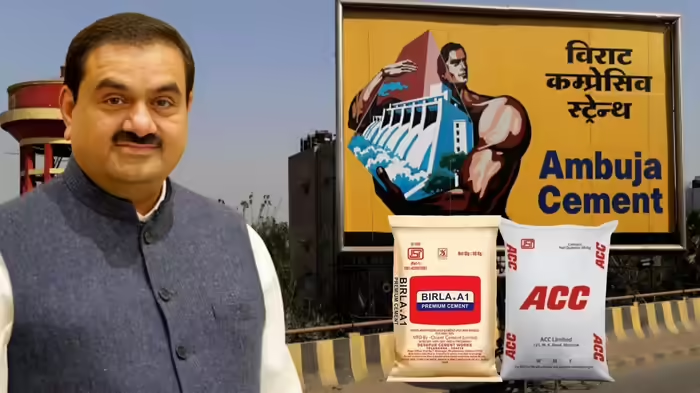
In a landmark decision, Ambuja Cements, part of the Adani Group, has approved the merger of its subsidiaries ACC Limited and Orient Cement with itself. The consolidation aims to create a major cement powerhouse in India, enhance operational efficiency, and optimize costs. The company’s goal is to boost profitability and deliver better returns to shareholders, signaling a transformative shift in the Indian cement industry. Creating a Pan-India Cement GiantThe merger will integrate ACC and Orient Cement into Ambuja Cements, streamlining manufacturing and logistics operations while ensuring efficient capital utilization. These structural improvements are expected to enhance profitability, support capacity expansion, and deliver long-term value to shareholders. By consolidating networks,...
China Shifts from Factories to Delivery: 14-Hour Shifts Become the Norm, Sparks Debate in India
Business & Economy

China Shifts from Factories to Delivery: 14-Hour Shifts Become the Norm, Sparks Debate in India

China is witnessing a rapid rise in gig workers who, despite 14-hour shifts and meager earnings, are compelled to take up these jobs. This trend highlights the slowdown in China’s economy and a scarcity of traditional employment. While the gig economy offers flexibility, it also exposes workers to low wages, insecurity, and hazardous working conditions, according to a report by The Wall Street Journal. The report comes at a time when India is also debating the exploitative aspects of the gig economy. Recently, Aam Aadmi Party (AAP) MP Raghav Chadha raised concerns over the challenges faced by gig workers in India. From Factories to Gig WorkOnce famous for its factories, China is increasingly becoming a country of gig workers, with their numbers exceeding 200 million. Gig work encompa...
Tata Elxsi Partners with Japanese Firm to Manufacture Automotive Semiconductor Chips in India
Business & Economy

Tata Elxsi Partners with Japanese Firm to Manufacture Automotive Semiconductor Chips in India

New Delhi: Automotive semiconductor chips, crucial for cars, mobile devices, IoT (Internet of Things), and artificial intelligence, have largely been imported until now. Tata Group’s company, Tata Electronics, has taken a major step to manufacture these chips domestically by partnering with Japanese semiconductor firm ROHM Co. Collaboration DetailsUnder this partnership, Tata Electronics and ROHM will assemble and test ROHM’s specialized Nch 100V, 300A Si MOSFET chips in India. These automotive-grade chips are specifically designed for vehicles, with large-scale production targeted by 2026. The collaboration aims to produce semiconductors for both Indian and global markets, leveraging ROHM’s advanced technology and Tata Electronics’ expertise in chip assembly and testing. Company Sta...
Good News Expected in February: RBI May Cut Repo Rate, Benefits for Borrowers
Business & Economy

Good News Expected in February: RBI May Cut Repo Rate, Benefits for Borrowers

New Delhi: The Reserve Bank of India (RBI) is likely to bring more good news for the public in February, with reports suggesting a potential cut in interest rates. According to a report by Union Bank of India, the RBI may reduce the repo rate by 25 basis points (bps) in its upcoming monetary policy meeting, bringing the benchmark rate down to 5%. The next monetary policy committee (MPC) meeting is scheduled for 4–6 February 2026. RBI’s Soft ApproachThe report highlights that given the RBI’s accommodative stance, there is room for an additional 25 bps cut in February or April 2026. The central bank has repeatedly noted that inflation is stable and price pressures are easing. If the impact of gold prices on inflation (around 50 bps) is adjusted, inflationary pressure appears even lower. ...