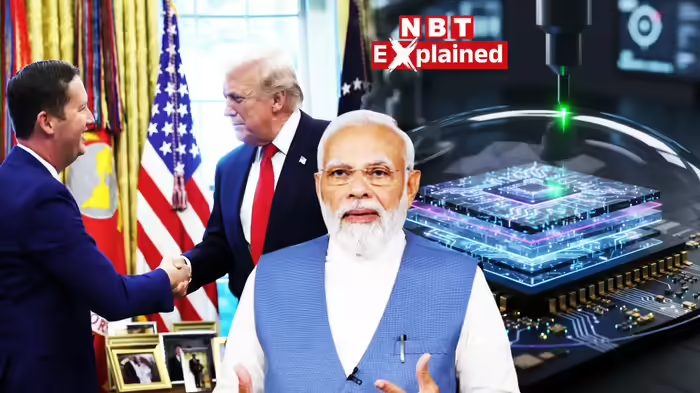
Washington/New Delhi: India is set to join the US-led strategic initiative, Pax Silica, aimed at securing critical minerals, advanced manufacturing, and semiconductor supply chains to counter China’s global influence. US Ambassador to India, Sergio Gore, announced on Monday that India would receive an official invitation to join the alliance next month.
Pax Silica, launched in December 2025, initially excluded India from its founding members. The decision to invite India now highlights Washington’s desire to strengthen strategic ties, even as bilateral trade relations remain strained. President Donald Trump has imposed a 50 percent tariff on Indian goods, and trade negotiations between the two nations have repeatedly stalled.
A Strategic Move Amid Tense Ties
Ambassador Gore emphasized that strong partnerships can endure disagreements: “True friends may disagree, but they always resolve their differences.” Gore, a close confidant of Trump, underscored the personal rapport between Trump and Prime Minister Narendra Modi, calling it “genuine friendship.”
What is Pax Silica?
Pax Silica is a US-led initiative to build a secure, innovation-driven silicon and critical minerals supply chain. Its goal is to reduce global dependency on China for essential resources, spanning from raw minerals and energy inputs to advanced manufacturing, semiconductors, AI infrastructure, and logistics. According to US Undersecretary of State Jacob S. Helberg, India’s entry represents a “major step toward a reliable and secure global supply chain” and a historic milestone for the US-India partnership.
Expert Insights
Robinder Sachdev, former Director of India Affairs at the US-India Political Action Committee, told Navbharat Times that Pax Silica will provide India access to cutting-edge technology, particularly in semiconductor manufacturing. “It’s a network encompassing technology, machinery, manufacturing, investment, and R&D, significantly reducing dependence on China,” he said.
Prof. Anshu Joshi from JNU’s School of International Studies noted that the alliance is strategically important for India, covering critical minerals, supply chains, energy, manufacturing, and technological collaboration. “However, India must ensure its national interests are safeguarded while engaging with a China-focused coalition and remind the US about the tariffs and trade barriers imposed by the Trump administration,” she added.
Why India Was Initially Excluded
Dr. Manan Dwivedi from the Indian Institute of Public Administration explained that India’s initial exclusion reflected the founding countries’ current roles in semiconductors and AI supply chains, rather than broader political alliances. The US had stated that discussions with India were ongoing and emphasized that Pax Silica is a strategic, not political, coalition.
Now, the invitation signals a shift: as global adoption of advanced technologies accelerates, India and the US have a rare opportunity to collaborate from the outset, potentially shaping the 21st century’s most significant global partnership. Ambassador Gore remarked, “What we can achieve together could become one of the most important partnerships of this century.”
Member Countries of Pax Silica
The founding members of Pax Silica include Japan, South Korea, Singapore, the Netherlands, the UK, Israel, UAE, and Australia, with Taiwan, the EU, Canada, and OECD countries participating as guests. Together, they form a network of leading corporations and investors powering the global AI and semiconductor supply chain—what US officials call the “Silicon Statecraft,” shifting global security focus from 20th-century resources like oil and steel to 21st-century essentials such as computing and critical minerals.
Discover more from SD NEWS agency
Subscribe to get the latest posts sent to your email.