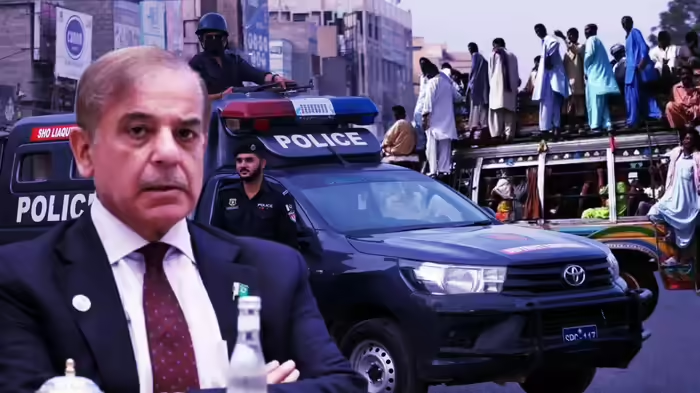
Islamabad: Pakistan’s largest province, Balochistan, has long been engulfed in violence, political unrest, and armed resistance. The province has become a focal point of conflict, with local insurgents clashing repeatedly with Pakistani security forces. The Baloch rebels claim to be fighting for their rights and independence, while the Pakistani government admits that controlling the uprising has become increasingly challenging.
Rising Threat to Pakistan
Recently, Pakistan’s Defence Minister Khawaja Asif acknowledged in Parliament that Baloch insurgents are better armed than before. According to him, individual rebels are equipped with military-grade gear worth up to $20,000, including assault rifles priced over $2,000 each—sometimes surpassing the equipment of Pakistani forces themselves. In response, the military has deployed helicopters, drones, and additional troops to suppress the rebellion.
Possibility of Balochistan Breaking Away
Reports indicate that large numbers of local residents, including women, are actively participating in the uprising. Analysts suggest this widespread involvement could pressure Pakistan to grant Balochistan greater autonomy. However, others warn that increased autonomy may escalate demands for full independence, potentially intensifying armed resistance and creating further instability. The prospect of Balochistan emerging as an independent state remains uncertain.
Size and Borders of Balochistan
Balochistan is Pakistan’s largest province, covering approximately 44% of the country’s total land area. Its total area is 347,190 sq km—larger than India’s largest state, Rajasthan (342,239 sq km). The province borders Iran to the west, Afghanistan to the north, and the Pakistani provinces of Sindh, Punjab, and Khyber Pakhtunkhwa to the east and northeast. Balochistan does not share a border with India. Strategically located on the Arabian Sea, its coastline spans around 77 km, including the deep-sea port of Gwadar, which is being developed under China’s CPEC project.
Population and Demographics
Balochistan has a population of approximately 15 million, composed of roughly 52% Baloch, 36% Pashtuns, and the remainder from Brahui, Hazara, and other communities. Quetta, the provincial capital, is the largest city with a population of about 1.6 million. Other major cities include Turbat and Khuzdar.
Strategic Importance for Pakistan
Balochistan is rich in natural resources, including natural gas, gold, copper, and coal, making it economically crucial for Pakistan. Its strategic location near the Strait of Hormuz and the Arabian Sea enhances its geopolitical significance. The province is also rich in rare earth elements, attracting global interest from countries such as China and the United States.
The ongoing insurgency and strategic significance of Balochistan make it a critical flashpoint for Pakistan, with both internal stability and international attention at stake.
Discover more from SD NEWS agency
Subscribe to get the latest posts sent to your email.