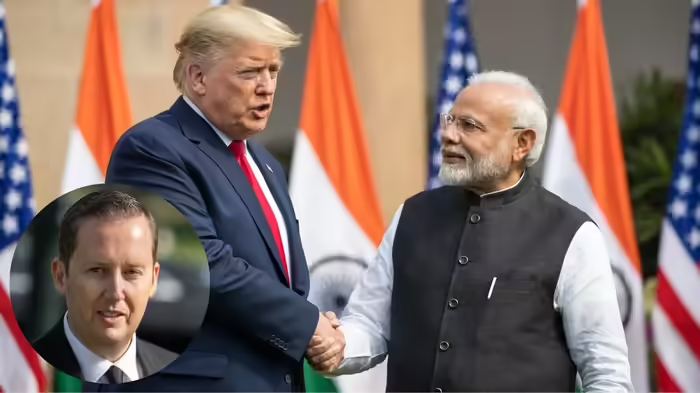
India and the United States have successfully concluded a major trade deal, and a key figure behind this achievement is Sergio Gor, the newly appointed U.S. Ambassador to India.
Sergio Gor: The Crucial Link in Delhi
Since his appointment in January, Ambassador Gor has played a pivotal role in strengthening U.S.-India engagement beyond traditional diplomatic channels. Even before the deal was officially announced by President Donald Trump, Gor hinted at a major development through a social media post. Following the announcement, he emphasized that President Trump has always regarded Prime Minister Narendra Modi as a close friend. Gor functioned almost as Trump’s special envoy in Delhi.
Visits Before Official Appointment
Although Gor formally assumed office on January 14 after presenting his credentials, he had already visited Delhi in October—a rare step in diplomatic protocol. During this visit, he met Prime Minister Modi, External Affairs Minister S. Jaishankar, and senior officials from the commerce department. He even presented PM Modi with a photograph from a previous joint press conference with President Trump, along with a personal message.
Timing and Communication Bridging
Last August, President Trump announced Gor’s appointment while U.S.-India trade relations were experiencing friction. The announcement came at a time when communication between the two countries on trade matters was limited, as evidenced by India repeatedly rejecting some of Trump’s controversial statements. Commerce Secretary Harvard Lutnick had even claimed that the deal had stalled because PM Modi had not contacted President Trump directly. Gor helped reduce this communication gap between Delhi and Washington.
Why Trump Trusts Gor
A close confidant of Trump, Gor is considered an influential insider at the White House. Trump has noted that Gor managed to appoint nearly 4,000 personnel across U.S. government departments in a very short time to advance his agenda. When former Ambassador Eric Garcetti left Delhi in January, Trump took seven months to choose the right successor, ultimately announcing Gor’s posting in August.
Practical Diplomacy Behind the Deal
Trump’s strategic use of tariffs as a diplomatic tool affected even India, prompting New Delhi to explore diversification in trade partnerships, including deals with the UK and the EU. In negotiations with the U.S., India maintained silence regarding some of Trump’s controversial remarks, balancing pragmatism and diplomacy.
EU Deal Sets Stage for U.S. Agreement
Experts believe India’s recently concluded trade deal with the EU caught Washington’s attention. The deal sent a message that India seeks diversified economic relations and does not want to be overly dependent on any single country. However, there is skepticism over whether India fully complied with Trump’s claims regarding reduced Russian oil imports, as India never formally acknowledged the assertions.
Measured Diplomacy and Strategic Patience
Managing heavy tariffs and controversial statements required India to respond with restraint. By simultaneously maintaining pragmatic relations with China and Russia, India demonstrated its role in the broader Global South partnership. Instances such as Trump’s discomfort with a photo of PM Modi alongside Xi Jinping and Vladimir Putin at Tianjin underscore the delicacy of these interactions.
The Road Ahead for Bilateral Relations
During Trump’s second term, uncertainties surrounding the trade deal created a temporary stalemate, complicating broader U.S.-India cooperation. This was reflected in the absence of joint appearances by PM Modi and President Trump at events such as the ASEAN Summit and the Sharm El-Sheikh summit on Gaza peace. With the trade deal now finalized, relations are expected to deepen, particularly in technology and AI. Reports indicate that India may also join the U.S.-led initiative, PAX Silica, further strengthening bilateral engagement.
Discover more from SD NEWS agency
Subscribe to get the latest posts sent to your email.