
Islamabad.
A political storm has erupted in Pakistan after the Shehbaz Sharif government announced its intention to carve out multiple new provinces by splitting existing ones. The unprecedented move—long avoided by Pakistani political parties—has triggered fierce opposition, not from rival groups, but from within the ruling alliance itself.
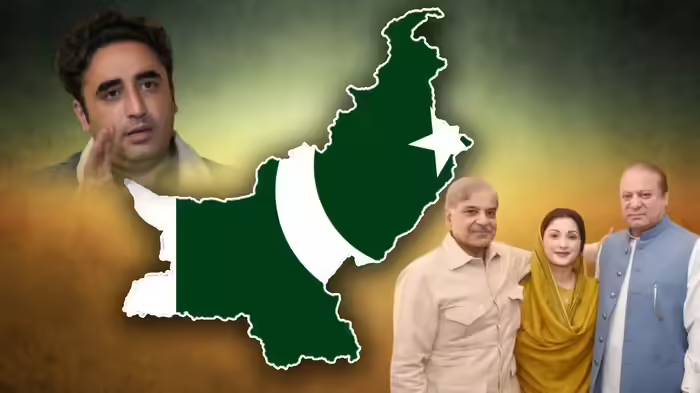
Federal minister Abdul Aleem Khan stated that the government plans to create three new provinces each from Sindh, Punjab, Balochistan and Khyber Pakhtunkhwa, arguing that smaller administrative units will ensure better governance. “All our neighbouring countries have several smaller provinces; Pakistan must adopt the same model,” he said.
However, the government’s key ally, the Pakistan Peoples Party (PPP) led by Bilawal Bhutto-Zardari, has openly challenged the plan, setting off a sharp political divide within the coalition.
Bilawal Bhutto: “Start with Punjab first”
The PPP has a stronghold in Sindh and has consistently opposed the division of the province. Sindh Chief Minister Murad Ali Shah has previously rejected any move to split Sindh. Bilawal’s fresh statement has added new political pressure on the Sharif government.
Bilawal said,
“Before talking about new provinces, implement the resolution passed by the Punjab Assembly. The Senate Commission has already recommended the creation of South Punjab as a separate province. Build consensus on that first, then move forward.”
His criticism carries weight because PPP’s support is crucial for the survival of the Shehbaz Sharif government.
Is Army Chief Asim Munir Behind the Push?
Political observers believe the real force behind the proposal may be Army Chief General Asim Munir. Pakistan has been grappling with widespread civil unrest, especially in Balochistan and Khyber Pakhtunkhwa, where anti-government and anti-military sentiments are rising sharply.
Pakistan’s crippling economy has further eroded public trust, making it increasingly difficult for both the government and the military establishment to maintain control.
Analysts say the creation of new provinces may be part of a larger strategy to restructure administrative control, decentralize power on paper, and tighten the military’s grip across local regions. The move could be aimed at diluting regional nationalism, weakening dissent, and reorganizing political dynamics to the Army’s advantage.
KP and Balochistan Could Be Split First
Sources indicate that the initial focus is on Balochistan and Khyber Pakhtunkhwa—two provinces where the state faces the most serious opposition. However, experts have warned that dividing volatile regions without deep political consensus could spark greater instability and chaos.
Experts Warn: “The Problem Isn’t Big Provinces—It’s Weak Institutions”
Retired senior bureaucrat Syed Akhtar Ali Shah stressed that province-creation must follow extensive historical and administrative analysis. “Poor governance, weak institutions, lack of democratic accountability, and corruption are Pakistan’s real problems. Dividing provinces without addressing these will only create new troubles,” he said.
Political analyst Ahmed Bilal Mehboob argued that past attempts to create new provinces have repeatedly failed and are likely to fail again. “This appears more like a political stunt designed to strengthen the authoritarian ambitions of the government and military. It may further fuel public anger rather than solve anything.”
Discover more from SD NEWS agency
Subscribe to get the latest posts sent to your email.