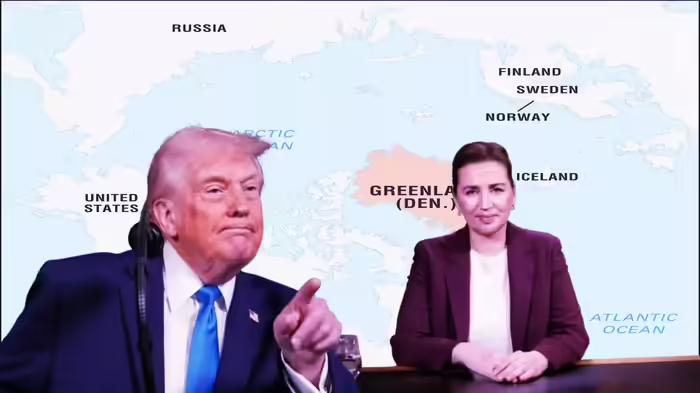
Copenhagen: U.S. President Donald Trump’s repeated threats to seize Greenland have triggered unprecedented tensions within NATO, raising serious questions about the future of the transatlantic alliance. Greenland, an autonomous territory of NATO member Denmark, has become the center of a geopolitical storm, with European allies openly pushing back against Washington’s aggressive rhetoric.
While NATO has elaborate contingency plans to counter external threats, the alliance has never prepared for a scenario in which a leading member threatens the sovereignty of another. Trump’s remarks targeting a fellow NATO country have exposed a strategic blind spot within the alliance. NATO Secretary General Mark Rutte has so far maintained silence, but analysts believe this approach may not be sustainable for long.
Danish Prime Minister Mette Frederiksen underscored the gravity of the situation earlier this week, warning that any U.S. military action against another NATO member would effectively bring the alliance to a standstill. “If the United States decides to attack another NATO country, everything stops—including NATO itself,” she said, adding that such an event would dismantle the post–World War II security architecture that has safeguarded Europe for decades.
A Longtime Russian Dream Comes True?
The internal discord within NATO is being viewed as a strategic windfall for Russian President Vladimir Putin. Patrick Oksanen, Senior Fellow at the Stockholm Free World Forum, remarked that even discussing such a scenario marks a historic victory for Moscow. “What we are witnessing now is something Soviet leaders could only dream of—deep divisions within NATO itself,” he said.
Trump Allies Fuel the Fire
Concerns intensified after comments by Trump’s close adviser Stephen Miller, who openly questioned Denmark’s sovereignty over Greenland. Miller asserted that no European country would go to war with the United States over Greenland, further inflaming tensions.
Adding to the unease, a recent social media post by Miller’s wife, Katie Miller, showed a map of Greenland draped in the U.S. flag with the word “Soon” emblazoned across it. The post has been widely interpreted as signaling serious intent. This speculation gained further traction after the White House stated that, as commander-in-chief, the U.S. president always retains the option of military action.
Europe Pushes Back
European opposition to Trump’s Greenland rhetoric is growing louder. Retired French General Michel Yakovleff warned in an interview that if Trump’s actions were to dismantle NATO, Europe would respond by expelling U.S. forces from the continent. “We will not go to war with the United States—we lack the means. But we can force them out of Ramstein, out of Naples. Not a single American ship would remain in the Mediterranean,” he said.
An Alliance at a Crossroads
Trump’s Greenland gambit has pushed NATO into uncharted territory, testing its unity and purpose like never before. What began as aggressive rhetoric has now evolved into a serious strategic crisis—one that could redefine the future of NATO and the balance of power in the Atlantic world.
Discover more from SD NEWS agency
Subscribe to get the latest posts sent to your email.