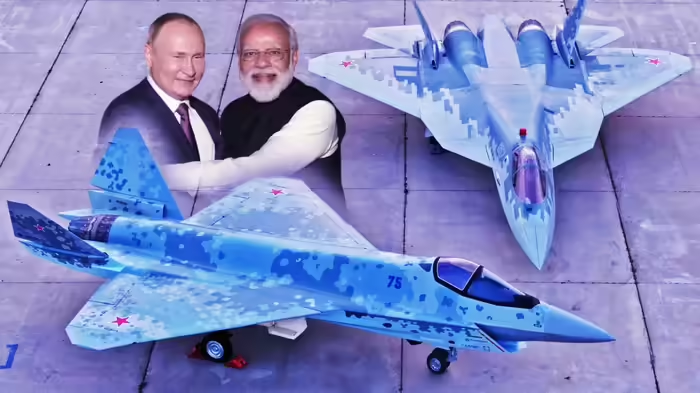
Despite repeated offers from Russia, India has so far refrained from committing to the acquisition of the Sukhoi Su‑57, Moscow’s fifth‑generation stealth fighter aircraft. While Russian officials claim they have offered India unprecedented concessions—including full technology transfer, access to source codes, and assistance in India’s indigenous Advanced Medium Combat Aircraft (AMCA) programme—the proposed deal continues to face significant hurdles.
Russia’s United Aircraft Corporation (UAC) has stated that technical‑level discussions with India are at an advanced stage. UAC CEO Vadim Badekha recently said that the Su‑57 could be manufactured in India under the “Make in India” initiative, potentially using existing facilities that currently produce the Su‑30MKI. Russian officials have also promised deep participation of Indian private and public sector firms in the aircraft’s production ecosystem.
Earlier, Rosoboronexport CEO Alexander Mikheev had announced that Russia was ready to offer the export variant Su‑57E to India, along with full transfer of technology, source code access, and support for India’s AMCA stealth fighter project—an offer rarely extended by Moscow to any partner.
What Is the Su‑57?
The Su‑57 is Russia’s first operational fifth‑generation fighter aircraft, developed to replace the MiG‑29 and Su‑27 fleets. Designed as a multirole platform, it is intended to perform air superiority, deep‑strike missions, suppression of enemy air defences, and network‑centric warfare in contested environments. The aircraft first flew in 2010 and was inducted into the Russian Air Force in 2020. However, even after more than a decade of development, its production numbers remain limited.
Concerns Over Stealth and Engine Performance
One of India’s primary concerns relates to the Su‑57’s stealth capabilities. Unlike the US‑made F‑22 and F‑35, the Su‑57 prioritises agility and manoeuvrability over extreme low observability. While it incorporates blended airframe shaping, internal weapons bays, and extensive use of composite materials, design elements such as exposed engine nozzles, panel alignment issues, and external sensor placement reduce its stealth effectiveness.
The aircraft’s powerplant is another major issue. The Su‑57 currently operates with the Saturn AL‑41F1 engine, which was introduced as an interim solution. Although powerful, it does not fully meet fifth‑generation benchmarks in terms of sustained supercruise, fuel efficiency, and infrared signature reduction. Russia is developing a next‑generation engine, known as Izdeliye 30, but it remains under testing and is yet to enter operational service.
Strengths and Limitations
Key strengths of the Su‑57 include:
- Exceptional manoeuvrability and high‑energy performance
- Capability to deploy long‑range air‑to‑air and air‑to‑ground weapons
- Design compatibility with manned‑unmanned teaming concepts
- Lower projected cost compared to Western fifth‑generation fighters
However, its limitations are significant:
- Lower stealth characteristics compared to Western counterparts
- An underdeveloped engine programme
- Limited production and operational maturity
- Challenges in integrating non‑Russian avionics and weapons
Why the Deal Is Stuck
India’s caution stems from past experience. New Delhi was earlier a partner in the Fifth Generation Fighter Aircraft (FGFA) programme based on the Su‑57 but exited the project due to concerns over cost, work share, technology access, and aircraft maturity. These issues continue to influence India’s current assessment.
Indian defence planners are particularly wary of compromising the country’s indigenous AMCA programme. While Russia’s offer of assistance is attractive, India wants to ensure that any foreign collaboration delivers tangible benefits to its domestic aerospace ecosystem without undermining long‑term self‑reliance and strategic autonomy.
India’s Urgent Need for a Fifth‑Generation Fighter
India faces an increasingly complex security environment, with threats on both western and northern fronts. China has already inducted the J‑20 stealth fighter and is developing the J‑35, while Pakistan has expressed interest in acquiring the J‑35 and Turkey’s KAAN fifth‑generation aircraft. In this context, India urgently requires a credible fifth‑generation capability to maintain air power balance in the region.
Yet, for New Delhi, the decision is not merely about filling an immediate capability gap. It is about ensuring long‑term technological sovereignty. Until concerns over cost, maturity, engine reliability, and alignment with India’s indigenous programmes are adequately addressed, the Su‑57 deal is likely to remain on hold.
In essence, India is not rejecting the Su‑57 outright—but it is unwilling to compromise its strategic vision for short‑term gains.
Discover more from SD NEWS agency
Subscribe to get the latest posts sent to your email.