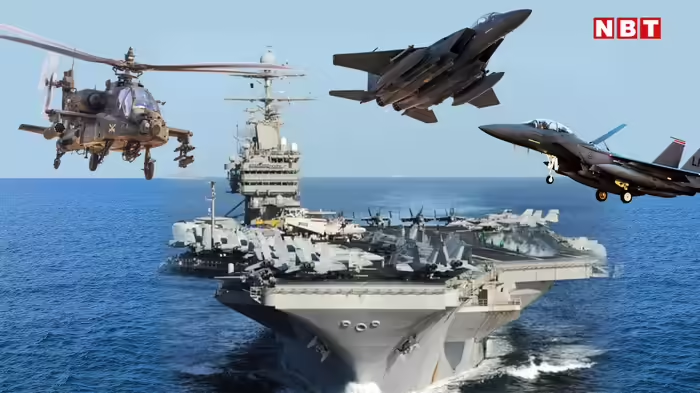
Tehran/Washington: Tensions in the Middle East have escalated sharply as Iran announced live‑fire military drills near the Strait of Hormuz and temporarily closed its airspace, even as the United States launched large‑scale military exercises in the region. The parallel moves have intensified fears of a direct confrontation between Tehran and Washington.
Iran issued a Notice to Airmen (NOTAM) on Tuesday, declaring live‑fire military activity in airspace near the Strait of Hormuz from January 27 to January 29. According to the advisory, airspace within a five‑nautical‑mile radius will remain restricted up to an altitude of 25,000 feet. The announcement came just hours after American military assets arrived in the region.
The Strait of Hormuz is a critical global chokepoint through which millions of barrels of crude oil pass daily. Any disruption in the area has the potential to shake global energy markets and escalate geopolitical tensions. Analysts believe Iran’s drills are intended as a strategic warning that it could disrupt global trade if attacked.
At the same time, the US Air Forces Central Command (AFCENT) announced a multi‑day military exercise aimed at demonstrating rapid deployment, sustainment, and combat readiness across the US Central Command’s area of responsibility. American officials reiterated that all options remain on the table, including military action, while Iran warned of a “swift and devastating” response to any strike.
The US Navy has already deployed the USS Abraham Lincoln aircraft carrier strike group to the region, comprising dozens of fighter jets, nearly 5,000 personnel, and multiple guided‑missile destroyers equipped with advanced air‑defense systems. According to US media reports, F‑15E Strike Eagle fighter jets—from the same unit involved in strikes against Iran in April 2024—have also been dispatched. The United Kingdom has reinforced its presence by deploying Typhoon fighter aircraft in a defensive role.
Iranian officials have stated that any attack—limited or otherwise—will be treated as a full‑scale war. “This is military preparation. We hope it does not lead to real confrontation, but Iran is fully prepared for the worst‑case scenario,” a senior Iranian official said. He added that any hostile action would be met with the “harshest possible response.”
Meanwhile, Saudi Arabia and the United Arab Emirates have reportedly assured Iran that they will not allow their airspace, territory, or waters to be used for military operations against Tehran, underscoring the region’s growing unease over the prospect of a wider conflict.
Discover more from SD NEWS agency
Subscribe to get the latest posts sent to your email.