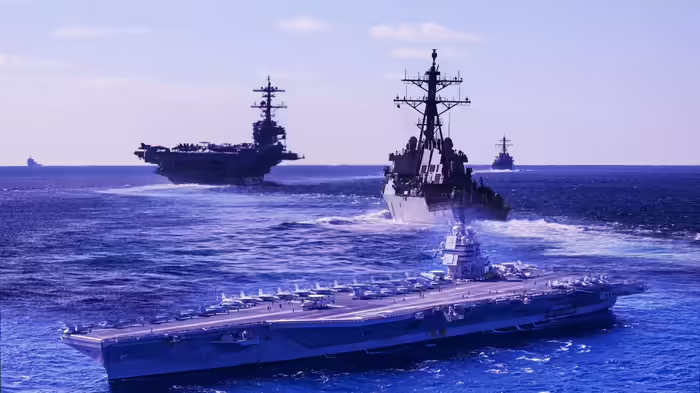
Tehran/Washington: The United States has significantly increased its military presence in the Middle East, deploying an aircraft carrier, USS Abraham Lincoln, along with three guided-missile destroyers—USS Frank E. Petersen Jr., USS Michael Murphy, and USS Spruance—to the Arabian Sea, near Iranian waters. These measures come as diplomatic efforts continue but concerns rise that a failure in negotiations could escalate into armed conflict.
Doubling Weapons in the Middle East
Open-source intelligence reveals that in the past two months, the U.S. has more than doubled its offensive military assets near Iran, a move reminiscent of its pre-Venezuela military buildup. While Iran is not as vulnerable as Venezuela, the warning is clear: any U.S. military strike could trigger a wider regional conflict. Iranian missiles could target U.S. bases, aircraft carriers, and Israel. Meanwhile, U.S. authorities have advised commercial vessels to avoid Iranian waters as a precaution.
U.S. Naval and Air Assets
The USS Abraham Lincoln Carrier Strike Group now operates alongside three additional destroyers, two near the Strait of Hormuz and one in the Red Sea. Approximately 5,700 U.S. service members have been deployed with the carrier. Three littoral combat ships—USS Santa Barbara, USS Canberra, and USS Tulsa—are also patrolling the Persian Gulf to detect and neutralize Iranian naval mines.
The U.S. Air Force has deployed F-15E Strike Eagles to enhance combat readiness and support regional security. Surveillance assets, including MQ-4C Triton drones, E-11A communication aircraft, P-8 Poseidon maritime patrol planes, and E-3G Sentry AWACS, are active in the region. Air defense systems such as THAAD and Patriot missiles at Qatar’s Al Udeid Air Base have been positioned to intercept potential Iranian missile strikes.
UK Joins U.S. in Regional Defense
The British Ministry of Defense recently deployed Eurofighter Typhoon jets to Qatar for defensive operations. Additional aircraft, including F-15s, MQ-9 Reaper drones, and A-10C Thunderbolt II ground-attack planes, have arrived at Jordan’s Muwaffaq Salti Air Base, enhancing combined defense capabilities.
Diplomacy Continues Amid Tension
U.S. and Iranian officials held talks in Oman regarding Iran’s nuclear program. Reports suggest that Iran offered to reduce uranium enrichment to below 60% in exchange for easing U.S. sanctions—a proposal receiving a positive response. Despite these talks, the U.S. has issued updated maritime guidance urging commercial ships to avoid Iranian waters, signaling a persistent military posture.
By deploying warships, aircraft, and missile defenses across the Middle East and Arabian Sea, the U.S. has substantially increased pressure on Iran. Iranian leadership is aware that while any conflict may be prolonged, sustained U.S. military action could severely degrade Iran’s capabilities, influencing Tehran to consider meeting U.S. demands.
Discover more from SD NEWS agency
Subscribe to get the latest posts sent to your email.