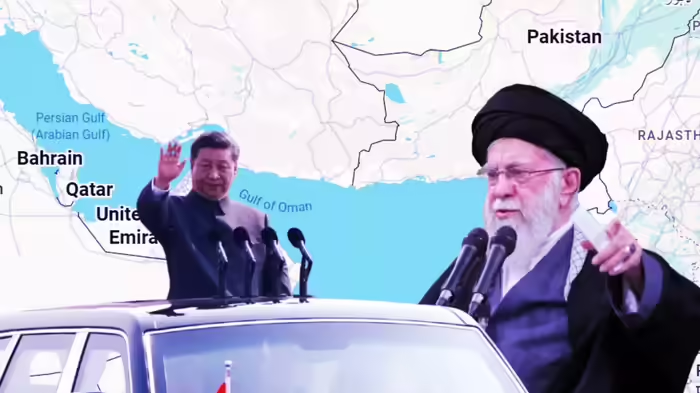
Tehran: Tensions between the United States and Iran continue to escalate, raising concerns of a potential conflict in the Persian Gulf. The US recently shot down an Iranian Shahed drone that was approaching the nuclear aircraft carrier USS Abraham Lincoln. Following this, US warships have deployed strategically in the Arabian Sea, putting Iran under pressure.
Iranian Foreign Minister Abbas Araghchi confirmed that nuclear talks with the US are scheduled for Friday in Muscat, Oman. Analysts warn that if these negotiations fail, the US could take decisive military action against Iran.
Implications for China
A military conflict involving Iran could send shockwaves across China. China imports a significant portion of its oil from Iran, and the Strait of Hormuz—a strategic waterway separating the Persian Gulf from the Gulf of Oman—could become China’s “new Malacca Strait,” a critical chokepoint. China’s industrial growth relies heavily on stable access to Middle Eastern oil, making the Strait of Hormuz vital to its energy security.
Previously, China relied on the Malacca Strait but faced the risk of supply disruptions by the US and India. To bypass this, Beijing invested $60 billion in the China-Pakistan Economic Corridor (CPEC) to transport oil and goods from Iran and other West Asian countries directly to the Gwadar port and overland to China. A US strike on Iran could jeopardize this plan.
China has historically purchased inexpensive oil from Iran and Venezuela. With US control over Venezuelan oil and the looming threat to Iranian supply, China’s energy security faces severe challenges. According to international data, China imported 13.18 million barrels of oil per day by the end of 2025. Despite growing renewable energy production, China’s petrochemical and heavy transport sectors still rely heavily on oil.
Strait of Hormuz: A Critical Chokepoint
Experts warn that the Strait of Hormuz is even more sensitive than the Malacca Strait. About 50% of China’s oil comes from the Persian Gulf. While pipelines offer alternative routes, the Strait remains a major extraction and export point. Its geography allows oil-producing nations to control supply, while consumer nations must ensure security to maintain industrial operations.
Global Impact: India and Beyond
A conflict in the Persian Gulf would have far-reaching effects on India and Europe. The Strait of Hormuz is only 33 km wide, with a navigable route of just 10 km—3 km each for incoming and outgoing traffic. Iran controls the northern part of the Strait, with air defense and missile systems capable of monitoring and restricting maritime movement. The shallow waters limit naval operations.
Currently, around 21 million barrels of oil, accounting for 20% of global consumption, pass through the Strait daily. Additionally, 90 million tons of LNG are exported annually via the Strait, supplying India and the rest of the world. India, as the world’s second-largest oil importer after China, could face significant disruptions.
The Strait of Hormuz thus remains one of the most strategically sensitive waterways globally, and any military escalation could have immediate economic and energy consequences across Asia and beyond.
Discover more from SD NEWS agency
Subscribe to get the latest posts sent to your email.