Washington/Tehran:
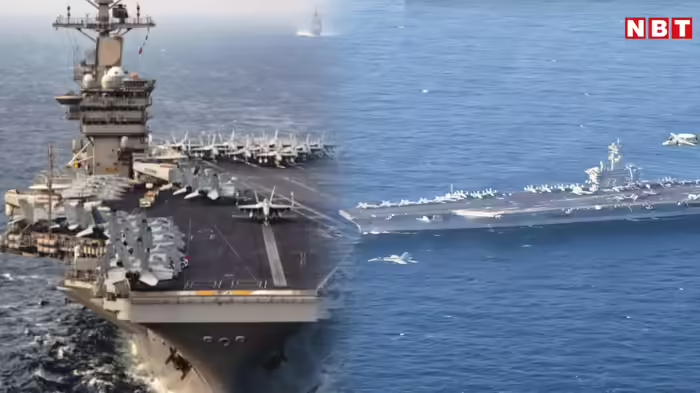
The United States has significantly escalated its military posture in the Middle East by deploying an aircraft carrier strike group to the Gulf of Oman and activating advanced THAAD (Terminal High Altitude Area Defense) missile systems at key regional bases. The move has intensified speculation over a possible US military strike on Iran.
According to senior US defense officials, additional air and missile defense systems are being positioned to protect American bases against potential Iranian retaliation. THAAD systems have reportedly been placed on high alert at US military installations in Jordan, Qatar, and the United Arab Emirates, alongside Patriot missile batteries.
Former President Donald Trump confirmed the movement of a large US naval armada toward the Gulf region, stating that the deployment is focused on Iran. While emphasizing that the buildup is precautionary, Trump remarked, “We are watching Iran very closely. A very large force is heading in that direction, and hopefully, we won’t have to use it.”
The USS Abraham Lincoln aircraft carrier, which was operating in the South China Sea just days ago, has altered its course and is now heading toward the Middle East. Its carrier strike group includes Arleigh Burke-class destroyers equipped with Tomahawk cruise missiles, capable of striking deep targets inside Iran. These vessels are also fitted with the Aegis Combat System, designed to counter ballistic and cruise missile threats.
Military analysts note that such a concentration of offensive and defensive assets is unlikely without a clear strategic objective. Many describe the current silence from Washington as a “calm before the storm.”
Iran, meanwhile, has issued sharp warnings. Ali Abdollahi Aliabadi, who coordinates operations between Iran’s military and the Islamic Revolutionary Guard Corps (IRGC), stated that any attack on Iran would trigger strikes on all US bases across the Middle East. IRGC Commander General Mohammad Pakpour added that Iran is “more prepared than ever, with fingers on the trigger,” cautioning the US and Israel against any miscalculation.
In an op-ed published in The Wall Street Journal, Iranian Foreign Minister Abbas Araghchi warned that Iran would retaliate with “everything it has,” asserting that a full-scale confrontation would be devastating and far longer than anticipated by Washington or Tel Aviv.
The rising tensions are already impacting civilian aviation. Several international airlines, including Air France, KLM, Transavia, and Luxair, have suspended or delayed flights to destinations such as Dubai and Tel Aviv, citing regional security concerns.
The US currently maintains 40,000–50,000 troops across the Middle East, with at least 19 permanent and temporary military bases in countries including Bahrain, Iraq, Kuwait, Qatar, Saudi Arabia, and the UAE.
As military deployments accelerate and rhetoric hardens on both sides, the region braces for a potential escalation that could have far-reaching global consequences.
Discover more from SD NEWS agency
Subscribe to get the latest posts sent to your email.