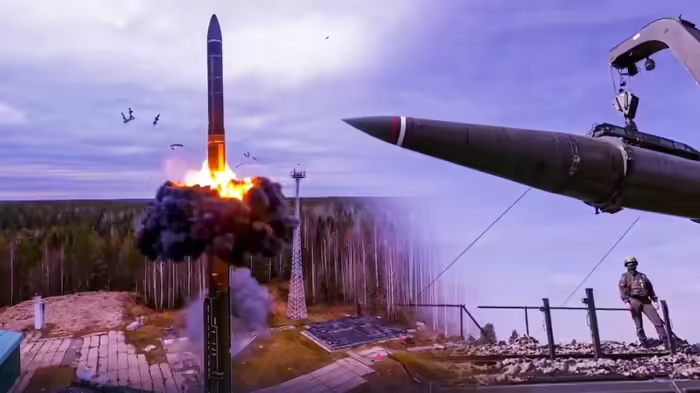
Moscow: Russia has once again deployed its Oreshnik hypersonic missile, marking the second use of the weapon in the four-year Ukraine conflict. The missile struck western Ukraine near the Polish border, targeting areas close to NATO allies, and was cited by Moscow as retaliation for a drone attack on President Vladimir Putin’s residence. European governments, however, interpret the strike as a direct warning to NATO.
A Missile That Reaches Across Continents
The Oreshnik, classified as an intermediate-range hypersonic ballistic missile, has a range of up to 5,000 kilometers, theoretically putting anywhere in Europe—and even parts of eastern North America—within reach. Thursday night’s missile landed near Lviv, roughly 60 kilometers from the Polish border, targeting a military base used for transferring arms to Ukraine.
Experts warn that the strike underscores Russia’s strategic and nuclear capabilities. The missile can carry nuclear warheads, making even a conventional strike potentially devastating. Russia first used the Oreshnik in November 2024, following the United States’ approval for Ukraine to launch HIMARS missile attacks inside Russian territory.
Why the Attack Raises Alarm
Analysts see the attack as Moscow’s attempt to remind the West of its strategic nuclear strength. European leaders pushing for increased troop deployments in Ukraine may have received a stark message from the missile launch. Additionally, Russia appears to signal disapproval of U.S. actions in Venezuela, highlighting broader geopolitical tensions.
The Power of the Oreshnik Missile
Known in Russian as “Hazel Tree,” the Oreshnik can reach speeds ten times faster than sound, making interception by conventional air defense systems virtually impossible. According to President Putin, even a conventional warhead on the Oreshnik can inflict destruction comparable to a nuclear strike.
Expert Analysis
Gerhard Mangott, a Russia expert at Innsbruck University, Austria, noted that Moscow is frustrated at being sidelined in negotiations between the U.S., Ukraine, and European nations. The missile launch sends a clear signal about Russia’s military capabilities and its readiness to influence European security calculations.
Former Russian President and Deputy Head of the Russian Security Council, Dmitry Medvedev, linked the launch to U.S. actions in Venezuela, including potential arrests and seizures of Russian-flagged tankers, while hinting at possible new sanctions from Washington.
The Oreshnik missile strike, combining long-range reach, hypersonic speed, and nuclear potential, has intensified fears across Europe and highlighted the ongoing volatility of the Ukraine conflict and Russia-NATO relations.
Discover more from SD NEWS agency
Subscribe to get the latest posts sent to your email.