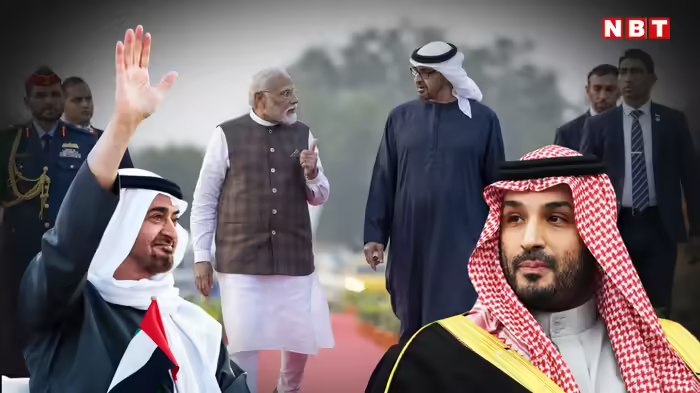
NEW DELHI / ABU DHABI: The historic alliance between United Arab Emirates (UAE) President Sheikh Mohammed bin Zayed Al Nahyan (MBZ) and Saudi Crown Prince Mohammed bin Salman (MBS) has come under severe strain, with tensions escalating over regional conflicts and strategic disagreements. MBZ is currently in New Delhi at the invitation of Prime Minister Narendra Modi, signaling the UAE’s effort to seek a trusted partner amid growing isolation from Saudi Arabia.
From Mentorship to Rivalry
Historically, MBS regarded MBZ as a mentor and guide, but their relationship has turned contentious. Analysts note that the feud reflects a larger struggle between “order and disorder” in the Middle East. UAE and Saudi Arabia, once closely aligned, now find themselves at odds over economic, military, and geopolitical influence in the Gulf and beyond.
Roots of the Conflict
Saudi Arabia supported the formation of the UAE in the 1970s and provided political and financial backing during its early years. However, as the UAE rapidly developed—particularly Dubai’s economic transformation in the 1990s—tensions emerged. Friction intensified in 2008 when the UAE independently signed cooperation agreements with Iran shortly after Saudi warnings over Iranian influence in the region.
UAE’s growing economic ties with Iran, as revealed by repeated US Treasury sanctions, and its independent military actions in Yemen, including support for anti-government groups and the Southern Transitional Council (STC), further strained relations. Despite Saudi-led coalition successes in Yemen, UAE maneuvers undermined Riyadh’s strategic goals, leaving the UAE increasingly isolated in the Islamic world.
Abraham Accords and Further Strains
The UAE’s participation in the Abraham Accords in 2020 and recognition of Israel deepened the divide with Saudi Arabia. Intelligence reports also implicated Abu Dhabi in covert operations in Yemen, Sudan, and Somalia, exposing its independent strategic agenda and leaving it without regional allies. Even Pakistan has sided with the Saudi-Turkish bloc, leaving the UAE increasingly reliant on partners like India.
India as a Strategic Anchor
MBZ’s visit to India underscores the UAE’s pursuit of a reliable partner amid its current isolation. Analysts emphasize that India’s strong economic and diplomatic ties with the UAE position it as a natural counterbalance to growing tensions with Riyadh. While India maintains relations with both Gulf powers, Delhi is unlikely to take sides explicitly, preserving its strategic autonomy.
The Gulf at a Crossroads
The UAE-Saudi rift highlights the shifting dynamics in the Middle East, where historic alliances are tested by competing ambitions, regional conflicts, and emerging partnerships. The evolving relationship between MBZ and MBS reflects the broader contest for influence, leaving the UAE navigating a delicate balance between isolation and strategic alignment.
Discover more from SD NEWS agency
Subscribe to get the latest posts sent to your email.