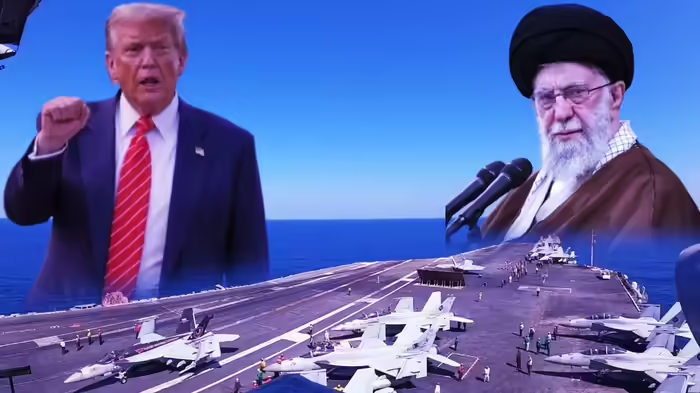
Washington: Amid escalating tensions with Tehran, U.S. military officials have revealed that preparations are underway for a major operation against Iran—potentially the largest American strike on the Islamic Republic to date. Sources speaking to Reuters on condition of anonymity said the campaign could extend over several weeks, significantly raising the risk of a large-scale conflict in West Asia.
The announcement comes shortly after Iranian and U.S. diplomats met in Oman last week to discuss Tehran’s nuclear program, a dialogue now overshadowed by military contingencies.
Deployment of Second Aircraft Carrier
The Trump administration is reportedly sending a second aircraft carrier to the Middle East as part of the operation. Officials confirmed that the deployment will include thousands of additional troops, fighter jets, guided-missile destroyers, and other advanced weapons systems designed both for offensive strikes and defensive operations.
Trump’s Hardline Stance
Speaking to U.S. troops at a North Carolina base on Friday, President Donald Trump underscored the difficulty of negotiating with Iran. “Sometimes you have to be willing to be feared. That’s the only way to really control the situation,” Trump said, fueling speculation about a potential strike. White House spokesperson Anna Kelly clarified, “The president retains all options in dealing with Iran.”
Scope of the Planned Operation
While the Pentagon declined to comment, past operations provide some context. In June 2025, the U.S. launched a one-time strike—codenamed ‘Midnight Hammer’—on Iran’s nuclear sites using two aircraft carriers and B-2 stealth bombers. Sources indicate that the forthcoming operation could be far more extensive, targeting not only nuclear facilities but also government and security installations across Iran. Officials declined to provide further details.
Risks of Retaliation
Experts warn that a full-scale operation against Iran carries serious risks. Tehran possesses the largest missile arsenal in the Middle East, and any retaliatory strikes could trigger prolonged conflict in the region. U.S. officials acknowledge that Iran is likely to respond, potentially resulting in a series of counterattacks lasting weeks.
This development marks a significant escalation in U.S.-Iran tensions, with the potential to reshape security dynamics across West Asia.
Discover more from SD NEWS agency
Subscribe to get the latest posts sent to your email.