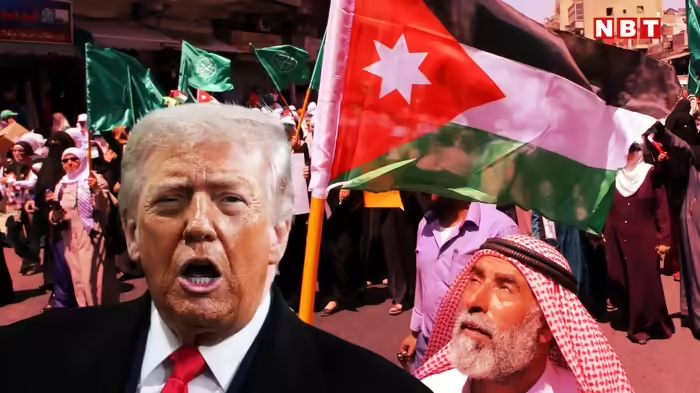
WASHINGTON: On 13 January 2026, the Trump administration officially designated the Muslim Brotherhood as a terrorist organization, a move expected to have far-reaching regional and global implications. The Muslim Brotherhood, founded in Egypt in 1928 by schoolteacher-turned-religious leader Hassan al-Banna, is a transnational Sunni Islamic movement with branches across several Arab countries.
Background of the Muslim Brotherhood
The organization, also known as Jamaat al-Ikhwan al-Muslimeen, was established with the aim of promoting Islamic governance and implementing Sharia law. While the Brotherhood initially engaged in social and educational activities, certain factions later turned to violence. Historical records indicate involvement in armed resistance against British colonial rule, opposition to Israel, and even the assassination of Egyptian Prime Minister Mahmoud Fahmi al-Nukrashi in 1948. Over the decades, the Brotherhood has alternated between periods of political influence and severe crackdowns, including mass arrests and executions of leaders in Egypt.
Despite some factions claiming to have abandoned violence, the group remains controversial for its ideological stance and alleged ties to militant activities in various countries. Its branches in Egypt, Jordan, Lebanon, Libya, and other regions have been active politically, though many operate underground due to legal restrictions.
UAE Welcomes the U.S. Move
The U.S. designation declares the Brotherhood’s transnational Sunni branches in Lebanon, Jordan, and Egypt as terrorist organizations. The decision has been warmly welcomed by the United Arab Emirates (UAE) and Saudi Arabia, long-standing critics of the Brotherhood. Officials in these countries view the group as a threat to national stability and a promoter of radical ideology that could destabilize their own political systems.
UAE authorities issued a statement praising the U.S. decision, emphasizing the importance of curbing extremist ideologies and protecting regional stability. Conversely, the move is a setback for Turkey, whose President Recep Tayyip Erdoğan has been ideologically sympathetic to the Brotherhood.
Global Reach and Current Status
Globally, the Brotherhood has affiliates and sympathizers in numerous countries, though most remain cautious due to legal pressures. Some branches, like Lebanon’s Al-Jama’a al-Islamiyya, are designated as Foreign Terrorist Organizations (FTOs), while others, including Egyptian and Jordanian factions, are listed as Specially Designated Global Terrorists (SDGTs) for providing support to Hamas. Countries such as Egypt, Saudi Arabia, UAE, and Russia have all officially declared the Brotherhood a terrorist organization.
The U.S. decision underscores the growing international consensus among some states to counter the influence of the Brotherhood, while highlighting ideological divides within the Muslim world.
Discover more from SD NEWS agency
Subscribe to get the latest posts sent to your email.