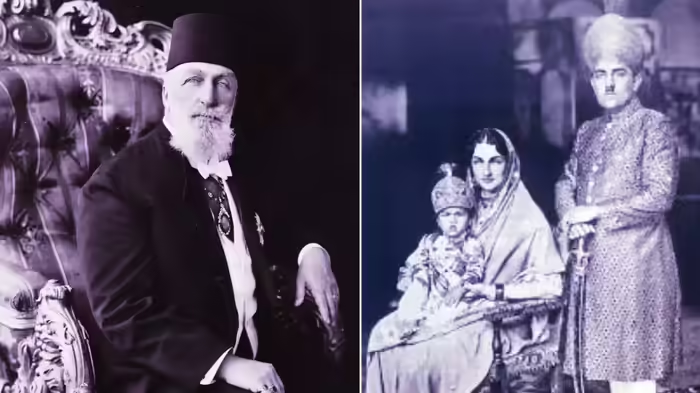
Istanbul: The early decades of the 20th century were a period of upheaval for the Islamic world. After siding with Germany in World War I, the Ottoman Empire faced defeat, leading to its partition by European powers and the emergence of modern Turkey. In 1924, the Turkish Republic, under Mustafa Kemal Atatürk, officially abolished the 1,300-year-old Islamic Caliphate, exiling the last Caliph, Abdulmejid II, from the country.
A Bold Attempt to Save the Caliphate
Despite exile, Abdulmejid II did not give up. Determined to revive the Caliphate, he devised a daring plan to establish legitimacy as the leader of the Muslim world without relying on Ottoman territorial power. His strategy involved garnering support from influential Muslim leaders and scholars worldwide, focusing on a region with the largest Muslim population at the time: British India.
The Role of Hyderabad and a Billionaire Prince
A crucial element of the plan was a marriage alliance between Abdulmejid II’s daughter, Princess Dürrüşehvar, and the son of Osman Ali Khan, the 7th Nizam of Hyderabad, who was considered the wealthiest man in the world at the time. The marriage, mediated by Indian politician and freedom fighter Shaukat Ali, was intended to produce a son who could be groomed as the new Caliph.
The choice of Hyderabad reflected India’s importance in the Islamic world, as other royal houses of Egypt and Iraq had also sought Dürrüşehvar’s hand. The plan symbolized a fusion of Ottoman prestige with India’s wealth and influence to revive the spiritual authority of the Caliphate.
Why the Plan Failed
Ultimately, the Caliphate revival plan failed. The 1947 partition of India and the subsequent integration of Hyderabad into India in 1948 ended the Nizam’s sovereign rule, removing the political and material foundation required for the scheme. Abdulmejid II’s vision, conceived in the wake of the Ottoman Empire’s collapse, could not withstand the emergence of a new Indian nation and the geopolitical realities of post-colonial South Asia.
Legacy of the Attempt
While the Caliphate never returned, this episode remains a remarkable historical footnote, highlighting the ambitions of the last Ottoman Caliph and the complex interplay of politics, royalty, and religion in the Indian subcontinent. As journalist Imran Mulla notes in his book The Indian Caliphate: Exiled Ottomans and the Billionaire Prince, the failed attempt underscores how historical aspirations can be thwarted by the tides of global change and nation-building.