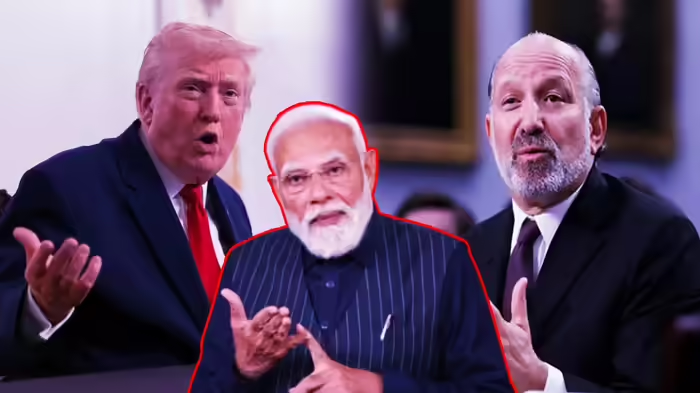
Washington: The long-awaited U.S.-India trade deal has hit a standstill, and a startling claim from U.S. Commerce Secretary Howard Lutnick has added fuel to the fire. In a recent interview, Lutnick stated that the agreement was fully prepared for signing but stalled because Indian Prime Minister Narendra Modi did not call President Donald Trump. According to Lutnick, everything was set, but a call from Modi to Trump was “mandatory,” and it never happened.
The statement hints at Trump’s insistence on a personal gesture, underscoring the former U.S. President’s preference for symbolic diplomacy and ego-driven acknowledgment.
Contradictory Claims Raise Questions
However, the claim raises eyebrows in light of Trump’s statement on January 6, when he said Modi had requested a meeting and that he had graciously agreed due to his “good relationship” with the Indian Prime Minister. Experts suggest the conflicting narratives may be a deliberate attempt to create pressure on India, casting doubt on U.S. intentions.
The Real Source of Friction: Agriculture and Market Access
Experts point out that the deal’s failure stems not from a missed phone call but from Trump administration demands India refuses to accept. The U.S. sought full access to India’s agricultural market, including grains, pulses, maize, dairy products, and genetically modified crops, while also seeking liberalization for American agricultural equipment. India has categorically rejected opening these sectors, citing potential harm to domestic farmers.
According to international affairs analyst Saurav Jha, Modi’s decision not to call Trump reflects a strategic calculation. He suggests that Washington has been attempting for decades to tilt India toward the U.S. orbit, even as Russia and China vie for influence. The current deadlock may indicate a shift in global alignments, with Washington attempting to assert leverage while maintaining parallel negotiations with Russia and China under the emerging G2 world order framework.
Three Possibilities Emerge:
- Trade Deal Stalled: India-U.S. trade agreement is ready but remains unsigned until the Russian war ends, with Europe holding a de facto veto.
- Last-ditch Leverage: The U.S. is attempting to secure India as a strategic “ally,” a medium-probability scenario labeled as Plan C.
- G2 Strategic Chessboard: The U.S. and China are reshaping global influence, with India potentially caught between competing superpowers—a scenario analysts consider most likely.
Former diplomat K.C. Singh notes that Trump-era negotiations were complicated by unexpected demands tied to personal egos and public visibility, making the “call” narrative plausible as a symbolic sticking point.
In short, the stalled deal reflects a deeper strategic calculus, rather than a mere lapse in protocol. India’s refusal to compromise on its agricultural and economic sovereignty appears to have provoked frustration in Washington, highlighting the complexities of modern U.S.-India trade diplomacy.
Discover more from SD NEWS agency
Subscribe to get the latest posts sent to your email.