
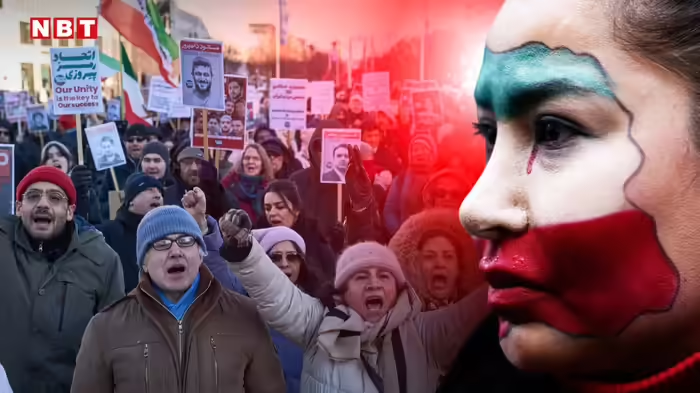
New York (Manish Gupta): The latest wave of protests in Iran began on December 28 last year. What started as a demonstration against the falling currency has evolved into a nationwide movement demanding the end of the current Khamenei-led regime. As the protests enter their third week, Tehran and cities across the country have erupted with public anger, driven by economic hardship, unemployment, and long-standing political frustration.
Iran, a highly educated and geopolitically significant nation, has historically been at the crossroads of internal and external conflicts. From religious influence and the export of revolutionary ideology to regional power struggles fueled by oil and politics, the country’s modern story reads like a geopolitical thriller. Today, the protests are fueled by deep-seated grievances spanning three generations.
A Legacy of Resistance
The roots of Iran’s anti-government sentiment date back decades. Until the 1950s, Iran maintained relatively friendly relations with Western powers. In 1953, Prime Minister Mohammad Mossadegh nationalized the oil industry, previously controlled by Britain. The US and UK orchestrated a coup to reinstate the Shah, planting the seeds of long-term anti-American sentiment among Iranians.
The 1979 Islamic Revolution, led by Ayatollah Khomeini, overthrew the Shah amid public outrage against corruption and Western influence, establishing the Islamic Republic. Since then, Iran has become the largest Shia Muslim country in the world, often at odds with the US, while engaging in regional proxy conflicts in Lebanon, Gaza, Yemen, Iraq, and Syria.
A Continuum of Protests
Iran has a long history of mass movements. The 2009 Green Movement, the 2019 fuel price protests, and the 2022 demonstrations following the death of Mahsa Amini all highlight the recurring struggle of Iranians against authoritarianism. Women have often been at the forefront, challenging oppressive norms and risking their lives for rights and justice.
This year, the protests are driven largely by economic collapse. Billions of dollars have been spent by the regime on conflicts abroad, while domestic unemployment, corruption, and mismanagement reach record levels.
The Trump Factor
Former President Donald Trump’s return to the political arena has added fuel to the fire. His bold moves, including the high-profile operation in Venezuela, signal that he is less inclined toward diplomacy or negotiation and more focused on “maximum pressure” and regime change. His statements and policies embolden the protesters while intensifying pressure on the Iranian leadership.
Khamenei’s Crucible
For Ayatollah Ali Khamenei, this is perhaps the greatest test of his decades-long leadership. Having spent a lifetime fortifying Iran against Western influence and pressure, he now faces the dual challenge of preserving both his power and the principles of the Islamic Revolution—a struggle for which Iran has already paid a heavy price over the past half-century.
Three Generations on the Streets
Today, Iran’s protests reflect the collective anger of three generations:
- The grandparents who witnessed the Shah’s fall and the rise of clerical rule.
- The parents who endured wars, sanctions, and the export of revolutionary conflicts.
- The Gen-Z youth who are confronting unemployment, inflation, and authoritarianism in the digital age, documenting and broadcasting the struggle to the world.
The protests are not just about economics or politics—they represent the soul of a nation seeking dignity, justice, and change. The streets of Tehran and other cities are alive with a movement that is both historic and unprecedented, capturing global attention and challenging the very foundations of the Iranian state.
Discover more from SD NEWS agency
Subscribe to get the latest posts sent to your email.