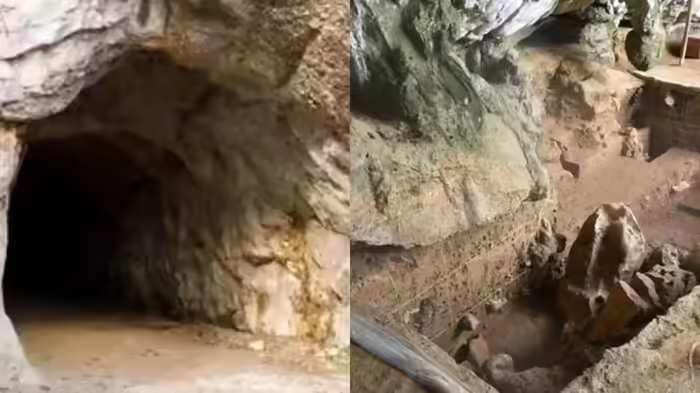
JAKARTA: In a groundbreaking archaeological discovery, scientists in Indonesia have uncovered evidence suggesting that modern humans and an ancient, now-extinct hominin species may have once shared the same living space. The findings come from the Leang Bulu Bettue cave in central Sulawesi, one of Indonesia’s largest islands, strategically located between mainland Southeast Asia and the Sahul region, which includes Australia and New Guinea. This location likely served as a key stopover for ancient populations moving eastward.
Excavations at the site have reached layers dating back 200,000 years. A striking change in archaeological records appears around 40,000 years ago, coinciding with the estimated arrival of Homo sapiens in the region. Beneath this layer, researchers discovered traces of an earlier population whose precise identity remains uncertain. These layers provide a rare transitional record, raising the possibility that two human species may have interacted in the same space.
A Deep Archaeological Record
Ongoing excavations in southern Sulawesi have been active since 2013. By 2023, researchers had completed a 26-foot-deep dig, with each layer representing thousands of years of occupation. The deepest layers, dating back 200,000 years, contain simple stone tools such as cobbles and flakes shaped to form cutting and piercing implements. Alongside these tools, the team discovered monkey bones—an unexpected find, as hunting such agile animals requires advanced planning and skill, suggesting that this early population may have been more capable than previously believed.
By 40,000 years ago, clear changes appear in tools, food remains, and symbolic objects, marking the arrival of modern humans and possibly altering the cave’s use. Although the overlap between Homo sapiens and the older hominin population remains uncertain, the proximity of these layers in time strongly suggests a potential interaction.
A Window into Human Evolution
Researchers say Leang Bulu Bettue offers one of the world’s best opportunities to identify the point of contact between human species. Sulawesi was home to hominins for millions of years before the arrival of modern humans, and deep excavations like this increase the likelihood of uncovering direct evidence of overlap. Experts are optimistic that further study of the site will shed light on how different human populations migrated, adapted, and potentially interacted in this region of Southeast Asia.
Discover more from SD NEWS agency
Subscribe to get the latest posts sent to your email.