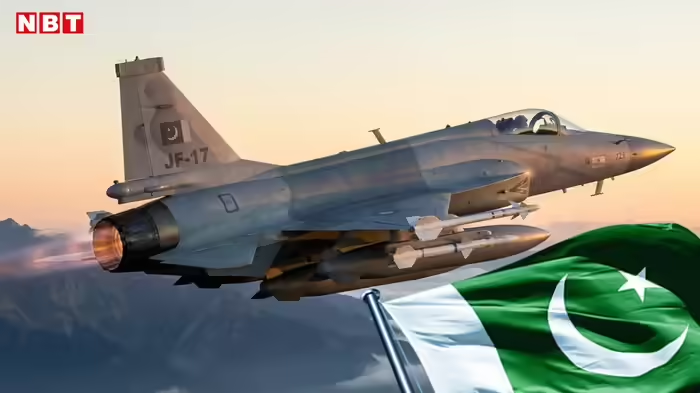
Pakistan is claiming growing international interest in its jointly produced JF-17 fighter jet, but the surge in demand may expose a major constraint: limited production capacity. The aircraft, co-developed with China, is attracting attention from countries including Saudi Arabia, Bangladesh, Iraq, Indonesia and Libya, according to Pakistani military officials. However, none of these governments has formally confirmed a purchase.
Demand Rising, Capacity Limited
Pakistan produces the JF-17 in partnership with China, which holds a 65% stake in the program, while Pakistan accounts for 35%. Despite the marketing push, Pakistan is capable of manufacturing fewer than 20 aircraft annually, and most of those are absorbed by its own air force. If multiple export orders materialize, Islamabad could struggle to meet delivery timelines.
Pakistan sees the JF-17 as a cornerstone of its ambition to expand arms exports and project regional influence. Yet analysts question how the country will scale production without significant investment in manufacturing infrastructure.
Why the JF-17 Appeals to Buyers
Manoj Harjani, a research fellow at Singapore’s S. Rajaratnam School of International Studies, described the JF-17 as a potential “market disruptor,” citing its affordability and reported battlefield performance.
“It is not hard to imagine the JF-17 being adopted more widely, especially by air forces that cannot afford Western-built fighter jets,” he said.
The aircraft is priced between $40 million and $50 million per unit, according to Pakistan’s Defense Production Minister Raza Hayat Harraj in an interview with BBC Urdu. By comparison, advanced versions of the Rafale or F-16 can exceed $100 million per aircraft.
Questions Over Potential Buyers
Despite reported interest, questions remain about whether key countries would ultimately choose the Pakistani jet. France has already begun delivering Rafale fighters to Indonesia, and Jakarta agreed in 2023 to purchase 24 Boeing F-15 jets. Saudi Arabia, meanwhile, relies heavily on American and European aircraft and is reportedly in talks with the United States over potential F-35 acquisitions.
Samir Lalwani, a senior fellow with the German Marshall Fund’s Indo-Pacific program, noted that expanding fighter jet production would require heavy financial investment. The challenge, he said, is whether Pakistan has the economic capacity to fund such an expansion.
For now, the JF-17’s rising visibility highlights both an opportunity and a bottleneck: strong marketing momentum paired with uncertain industrial capability.
Discover more from SD NEWS agency
Subscribe to get the latest posts sent to your email.