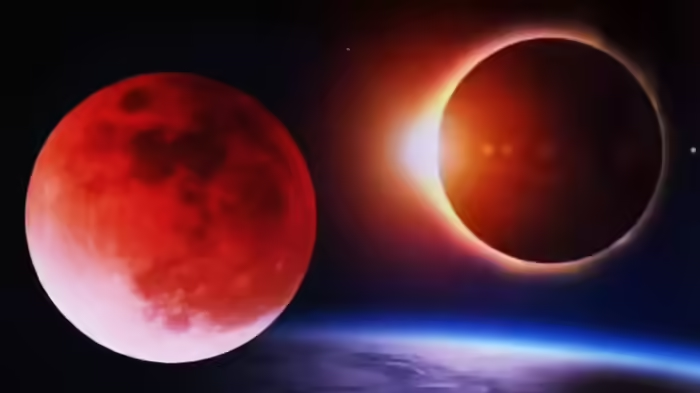
Washington: The first solar eclipse of 2026 will occur today, Tuesday, 17 February. This will be an annular solar eclipse, popularly known as the “Ring of Fire,” visible only from select regions of the world. An annular eclipse occurs when the Moon passes between the Earth and the Sun but appears smaller than the Sun in the sky, leaving a bright ring around the Moon. Unfortunately, this eclipse will not be visible from India.
The “Ring of Fire” phase will be visible mainly in the icy regions of Antarctica, while a partial eclipse can be observed from parts of South Africa, southern South America, and some areas in the Indian Ocean.
Upcoming Lunar Eclipse and Blood Moon
Astronomers are already preparing for the full lunar eclipse on 3 March 2026, which will be visible across a much larger part of the world, including India. Unlike solar eclipses, which require special protective eyewear, a lunar eclipse can be safely observed with the naked eye.
A lunar eclipse occurs when the Earth comes between the Sun and the Moon, casting its shadow on the Moon. The Earth’s shadow has two parts: the outer penumbra, which causes a faint dimming, and the inner umbra, which is much darker. When the Moon passes through the umbra, it does not disappear completely but appears red or orange, giving rise to the phenomenon known as a Blood Moon.
The 3 March lunar eclipse will be visible in various time zones: early morning in North and Central America, evening in East Asia and Australia, and notably from India. Observers across the Pacific Ocean will see it at night. Unfortunately, Africa and Europe will not have visibility of this lunar eclipse.
Discover more from SD NEWS agency
Subscribe to get the latest posts sent to your email.