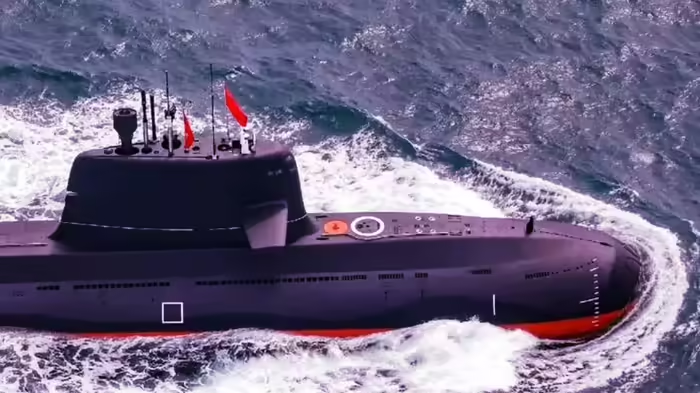
China has further strengthened Pakistan’s naval capabilities by handing over the fourth and final Hangor-class submarine, equipped with Air-Independent Propulsion (AIP) technology, significantly enhancing Islamabad’s underwater warfare potential in the Arabian Sea and the wider Indian Ocean Region (IOR). The development is being viewed by defence experts as part of a broader China-Pakistan strategy to counter India’s growing naval dominance.
On December 17, 2025, China officially delivered the submarine to the Pakistan Navy at the Wuchang Shipbuilding Industry Group in Wuhan. Notably, Pakistan has named the new submarine PNS Ghazi, symbolically reviving the name of the Pakistani submarine sunk by the Indian Navy during the 1971 Indo-Pak war—a move widely interpreted as a psychological and strategic signal.
According to a statement released by the Pakistan Navy, the induction of PNS Ghazi marks a “major milestone,” with all four China-built Hangor-class submarines now entering advanced sea trials ahead of their formal commissioning.
AIP Technology: A Silent but Serious Threat
The Hangor-class submarines are diesel-electric attack submarines fitted with Air-Independent Propulsion (AIP), a technology that allows submarines to remain submerged for extended durations without surfacing. This significantly enhances stealth, survivability, and operational reach—often compared to stealth capabilities in fifth-generation fighter aircraft.
These submarines are export variants of China’s advanced Type 039B Yuan-class, designed for covert operations and sea-denial missions. Military analysts believe the submarines can be armed with anti-ship cruise missiles, advanced torpedoes, and potentially the naval variant of Pakistan’s Babur land-attack cruise missile, substantially expanding Pakistan’s strike options from underwater platforms.
China-Pakistan Submarine Deal
In 2015, Pakistan signed a deal with China to acquire eight Hangor-class submarines. Under the agreement, four submarines are being constructed in China, while the remaining four will be built at Karachi Shipyard & Engineering Works (KS&EW) under technology transfer arrangements. The first batch is expected to enter operational service by 2026.
Once fully inducted, Pakistan will operate 11 AIP-capable submarines, combining Hangor-class vessels with its existing Agosta-90B fleet—giving it one of the largest AIP-enabled submarine forces in the region. In contrast, India’s indigenous AIP submarine program remains in the planning and negotiation phase.
Beyond Submarines: Expanding Naval Cooperation
China-Pakistan naval cooperation extends well beyond submarines. China has also supplied Pakistan with Type-054A/P Tughril-class frigates, each displacing around 4,000 tonnes and equipped with CM-302 supersonic anti-ship missiles, HQ-16 air defence systems, and advanced sensors. These multi-role frigates significantly boost Pakistan’s air defence, anti-submarine, and surface warfare capabilities.
Additionally, Chinese Z-9EC naval helicopters and unmanned platforms have further enhanced Pakistan’s maritime surveillance and anti-submarine warfare capacity in the Arabian Sea and Indian Ocean.
Strategic Implications for India
Defence experts caution that the rapid modernization of Pakistan’s navy, backed by China, could alter the regional maritime balance. The growing underwater strike capability strengthens Pakistan’s sea-denial doctrine, increasing challenges for Indian naval operations, particularly near critical sea lanes and coastal areas.
As China continues to project influence through Pakistan, the Indian Ocean is increasingly emerging as a key theatre of strategic competition—making undersea dominance a crucial factor in future regional security dynamics.
Discover more from SD NEWS agency
Subscribe to get the latest posts sent to your email.