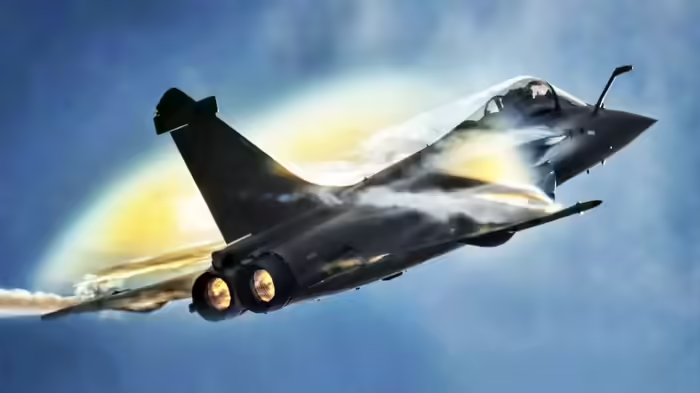
Paris: India currently operates the Rafale F3-R variant, while France has already moved ahead with the F4 version, now in production for select international customers. But ahead of both lies the much-hyped Rafale F5—Dassault Aviation’s so‑called “Super Rafale.” The F5 has cleared multiple test milestones and is being marketed as a next-generation fighter with advanced sensors, network-centric warfare capabilities, and powerful electronic warfare suites.
However, despite its impressive upgrades, a critical question is rising globally: Can the Rafale F5 survive the next era of air combat, which is rapidly shifting toward stealth, AI-driven targeting, and fully fused sensor ecosystems?
The Rafale’s Fundamental Weakness: An Airframe From a Pre-Stealth Era
The biggest challenge facing the Rafale F5 is not its technology—but its design heritage. Its airframe predates the stealth era and was never engineered to be truly low‑observable.
While the F5 can deceive enemy radars, jam hostile sensors, and outmaneuver threats, it cannot disappear. In the coming decade, when invisibility becomes the deciding factor in survival, visibility will become its greatest weakness.
Meanwhile, the world is rapidly moving toward fifth- and sixth-generation platforms.
- The U.S. is developing the F‑47 NGAD,
- China is pushing ahead with the J‑36 and J‑50,
all designed from the ground up to dominate in an AI‑integrated stealth battlespace.
Against these new-age fighters, even an advanced Rafale struggles to remain competitive.
Why Experts Are Calling It a “Costly Illusion”
Despite being marketed as a 4.5+ generation powerhouse, the Rafale F5 competes in price with true fifth-generation jets—often costing as much as, or even more than, the F‑35.
But capability-wise, the gap is widening:
- The F‑35 has evolved beyond a stealth strike platform—
it is now an aerial sensor-fusion node, integrating land, air, sea, and space assets into a single kill-chain network. - The F‑22 remains unmatched in air superiority.
Together, they build an impenetrable sensor web that identifies, tracks, and eliminates threats long before they even know they are under observation.
In comparison, even a fully modernized Rafale F5 struggles to penetrate this network—or hide from it.
Experts warn that countries investing in older airframes, howsoever upgraded, may be choosing sentiment over survival. Their adversaries may not make the same mistake.
Rafale F5: The Best Rafale Ever—Yet Still Behind
Technically, the F5 is the most capable Rafale yet:
- cutting-edge sensors,
- enhanced electronic warfare,
- expanded weapons load,
- superior digital integration.
Sleek, lethal, and far more advanced than its predecessors.
Yet, it remains detectable.
Its aerodynamic design and radar signature make it vulnerable to the kill-chains of stealth fighters and next-gen systems.
This is why defense analysts caution powerful air forces—especially those facing serious external threats—to evaluate carefully before backing the Rafale F5 as their frontline fighter in the coming era.
Discover more from SD NEWS agency
Subscribe to get the latest posts sent to your email.