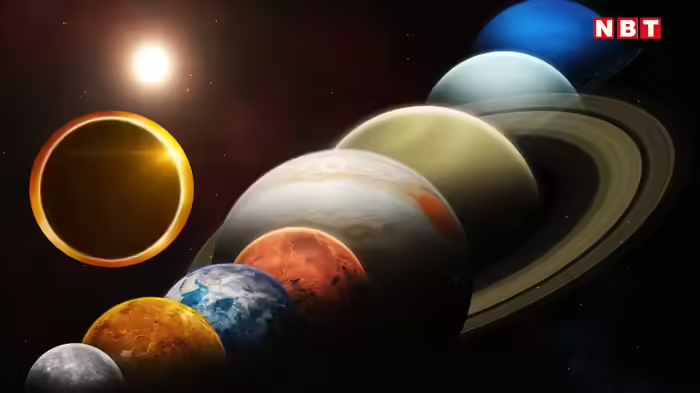
Washington: February 2026 promises to be an extraordinary month for space enthusiasts, with several exciting celestial events set to unfold. Astronomers have been eagerly anticipating these phenomena, which include both a rare planetary alignment and the year’s first solar eclipse.
‘Ring of Fire’ Solar Eclipse
On 17 February, during the new moon, the Moon will pass between the Sun and Earth, creating an annular solar eclipse, famously known as a “Ring of Fire.” Unlike a total solar eclipse, the Moon will not completely cover the Sun because it will be near its farthest point from Earth. As a result, the Sun’s outer corona will remain visible, forming a brilliant fiery ring.
According to National Geographic, at the peak of the eclipse, the Moon will cover 92% of the Sun’s disk, producing a glowing halo effect. The spectacle will last for approximately 2 minutes and 19 seconds. However, viewing opportunities will be limited: the eclipse will be fully visible only from Antarctica, with partial visibility in parts of South America and South Africa.
Planetary Parade
Later in the month, the solar system will stage a dazzling planetary parade. On the night of 28 February, six planets—Jupiter, Uranus, Neptune, Mercury, Saturn, and Venus—will appear aligned in the evening sky after sunset. This celestial alignment will be observable from India, North America, Europe, and Australia.
Planets Mercury, Venus, Saturn, and Jupiter can be seen with the naked eye, while Uranus and Neptune will require a telescope. Clear skies will be essential to enjoy this rare astronomical display.
For astronomy enthusiasts, February 2026 offers a once-in-a-year opportunity to witness the wonders of the cosmos—from the fiery elegance of the annular solar eclipse to the serene alignment of distant worlds.
Discover more from SD NEWS agency
Subscribe to get the latest posts sent to your email.