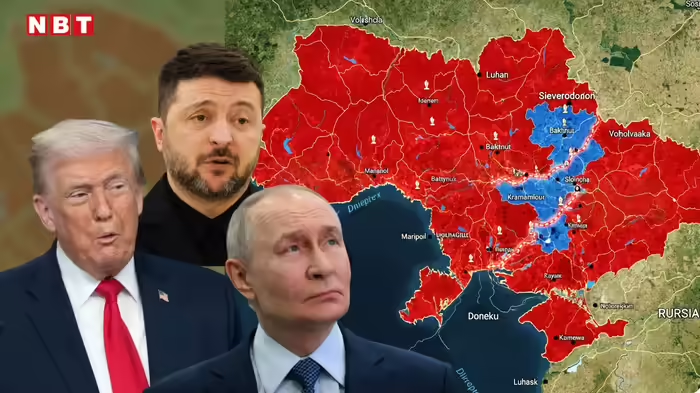
As Russian missiles continued to rain down on Kyiv, senior officials from Russia, Ukraine and the United States held their first-ever trilateral peace talks in the United Arab Emirates, marking a historic but fragile diplomatic moment in a war now nearing its fourth year.
The talks, held in Abu Dhabi on Friday and Saturday under US mediation, did not yield an immediate breakthrough, but all sides described the discussions as constructive, raising cautious hopes for further engagement.
Ukrainian President Volodymyr Zelenskyy, responding to the meeting, said dialogue must continue despite the battlefield realities.
“Many things were discussed, and it is important that the conversation was constructive,” Zelenskyy wrote on social media platform X. “The main focus was on possible parameters for ending the war.”
According to CNN, a senior US official confirmed that the meeting was the result of months of behind-the-scenes diplomacy, stressing that no progress was possible without direct talks. This was the first time since the war began on February 24, 2022, that representatives of all three countries sat at the same table.
Talks Continue Even as Russia Launches Major Air Assault
The symbolism of the meeting was underscored by events on the ground. On the very night the negotiations were underway, Russia carried out its largest aerial attack of the year on Ukraine, highlighting the stark disconnect between diplomacy and the battlefield.
While no agreement was reached, both sides expressed willingness to continue discussions. Zelenskyy said Ukraine was ready for another round of talks as early as next week, provided there was genuine intent to move forward.
US President Donald Trump’s special envoy Steve Witkoff, who participated in the talks, described them as “very constructive” and confirmed plans to continue negotiations in Abu Dhabi.
Ukraine Demands Ironclad Security Guarantees
US officials have indicated that the next meeting could take place on February 1. Zelenskyy emphasized that Ukraine’s top priority remains binding security guarantees, particularly from the United States, to ensure long-term stability after the war.
“For us, security guarantees are the key issue—primarily bilateral guarantees with the United States,” Zelenskyy said at a press conference in Lithuania.
“The document is 100 percent ready. We are waiting for our partners to finalize the date and place for signing.”
He added that any agreement would require approval from both the US Congress and the Ukrainian parliament, underscoring the political complexity of the process.
Donbas: The Core Deadlock
At the heart of the stalemate lies Donbas, eastern Ukraine’s coal-rich region comprising Donetsk and Luhansk, large parts of which are currently under Russian control.
Ahead of the Abu Dhabi talks, Kremlin spokesperson Dmitry Peskov made it clear that Ukraine relinquishing Donbas remains a non-negotiable demand for Moscow. Russia controls nearly 99–100 percent of Luhansk and approximately 75–80 percent of Donetsk, while Ukraine still holds around 20 percent of the territory.
President Vladimir Putin has recently insisted that Ukraine withdraw completely from these remaining areas as a precondition for a ceasefire.
“Russia’s position is clear,” Peskov said. “Ukrainian forces must leave Donbas. This is an essential condition.”
Russian Deputy Foreign Minister Sergey Ryabkov echoed this stance after the talks, telling state news agency TASS that Moscow seeks a settlement aligned with the “basic understandings” reached during last year’s Putin–Trump summit in Alaska.
Ukraine Refuses Territorial Concessions
Ukraine, however, remains defiant.
“We are fighting for our country—for what is ours,” Zelenskyy said. “We are not fighting on someone else’s land. What questions can there be?”
Despite strong pressure from Washington for territorial concessions as part of a peace deal, Kyiv has so far refused to cede any occupied territory. President Trump himself has acknowledged that any agreement would require compromise between “two completely different positions,” raising questions over how long Ukraine can withstand diplomatic and military pressure simultaneously.
A Long Road Ahead
With Donbas remaining the most active and contested battlefield, Russia seeks to consolidate full control before agreeing to a ceasefire, while Ukraine insists on restoring its territorial integrity.
The Abu Dhabi meeting may not have brought peace closer, but it marked a critical diplomatic milestone—the first time since the war began that all three key players formally engaged in direct talks. Whether diplomacy can outpace the missiles over Kyiv remains the defining question in the weeks ahead.
Discover more from SD NEWS agency
Subscribe to get the latest posts sent to your email.