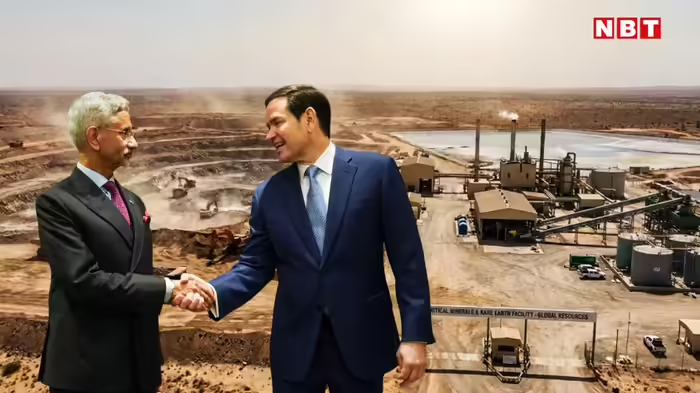
Washington/New Delhi: The United States is spearheading a major international coalition on critical minerals, named Pax Silica, aimed at reducing global dependence on China for rare earths. The alliance, which initially includes 20 countries, will hold its first meeting in Washington from 2–4 February. India, along with Australia, Japan, the European Union, the UK, and New Zealand, is participating in the summit.
India’s Foreign Minister Dr. S. Jaishankar will attend the Critical Minerals Ministerial convened by U.S. Secretary of State Marco Rubio. The meeting will focus on forming a strategic partnership to secure the supply chain for essential minerals critical to semiconductors, AI technologies, electric vehicles (EVs), and clean energy infrastructure.
Strategic Goals and Geopolitical Context
Pax Silica is being viewed as a countermeasure to China’s dominance in rare earths. The initiative comes amid rising global tensions and supply chain disruptions, including last year’s export restrictions imposed by China in response to U.S. tariffs. The U.S.-led alliance also aims to restore transatlantic ties strained under the previous Trump administration and promote collaboration with trusted allies.
Key agenda items for the summit include:
- Securing the mining, processing, and supply chains of lithium, cobalt, and other critical minerals.
- Reducing dependence on China for semiconductors, AI hardware, and EV battery production.
- Promoting collaboration on semiconductor chip manufacturing and design.
- Establishing shared networks for data centers, computing power, and AI infrastructure.
- Discussing a possible framework for minimum prices for essential minerals, though the Trump administration had previously rejected such proposals.
Australia has announced plans to create a strategic reserve of critical minerals worth AUD 1.2 billion, mirroring Japan’s approach, to mitigate supply chain risks from China. This includes stockpiling elements such as antimony and gallium to secure multi-year reserves.
Global Participation and Significance
The summit will include G7 countries (the U.S., UK, Japan, France, Germany, Italy, and Canada), along with India, South Korea, Mexico, Australia, New Zealand, and potentially Argentina. Officials emphasize that a successful outcome could result in a joint declaration, marking a milestone for the U.S. and its allies in shaping a multipolar, resilient economic ecosystem for strategic minerals.
The U.S. State Department emphasized that “strengthening international partnerships in critical mineral supply chains is vital for the American economy, national security, technological leadership, and a sustainable energy future.”
Discover more from SD NEWS agency
Subscribe to get the latest posts sent to your email.