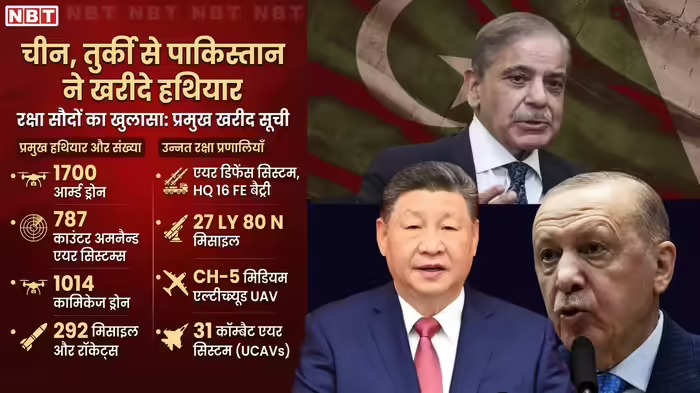
In a significant boost to its military capabilities, Pakistan has carried out large-scale defence acquisitions from China and Turkey, drawing lessons from last year’s confrontation with India following Operation Sindoor, Indian intelligence agencies have confirmed.
According to intelligence assessments accessed by Hindustan Times, the Pakistani military has spent several billion dollars on advanced weapon systems spanning air, land, and sea domains. The acquisitions include air defence systems, long-range missiles, unmanned combat aerial vehicles (UCAVs), loitering munitions, kamikaze drones, tanks, attack helicopters, warships, hovercraft and submarines—primarily sourced from Beijing and Ankara.
During Operation Sindoor, India destroyed nine terror camps and subsequently carried out precision strikes on 11 Pakistani air bases, establishing air superiority. In the aftermath, Pakistan accelerated defence procurement to address vulnerabilities exposed during the conflict.
Massive UAV and Drone Expansion
Pakistan has reportedly acquired 31 Unmanned Combat Aerial Vehicles (UCAVs), including one Turkish Akinci High-Altitude Long-Endurance (HALE) drone and 30 Chinese Caihong CH-4 and CH-5 drones, platforms comparable to the US MQ-9B Predator. These UCAVs are claimed to have operational ranges exceeding 6,000 km, can fire air-to-air missiles, carry laser-guided bombs, and operate at altitudes above 8 km.
Additionally, Pakistan has procured over 1,014 long-range loitering munitions (kamikaze drones) with ranges exceeding 200 km. These include Turkish YIHA and Kargu systems and Chinese DA-II, DA-IV and Oscar-I drones. More than 1,700 short-range kamikaze drones—capable of swarm attacks—have also been purchased from China and Turkey.
Air Defence and Counter-Drone Systems
To counter India’s air dominance, Pakistan has inducted two batteries of Chinese HQ-16 FE surface-to-air missile systems with a range of 160 km. It has also procured 27 LY-80N ship-based air defence missiles for its Chinese-built frigates.
Intelligence inputs further reveal the acquisition of 787 counter-unmanned aerial systems, including 763 soft-kill (jamming) and 24 hard-kill (shoot-down) systems, significantly strengthening Pakistan’s anti-drone defences.
Missiles, Tanks and Helicopters
Pakistan has also bought an additional battery of Chinese Fatah-1 terminally guided rockets (100 rockets) and 192 HD-1 supersonic land-attack missiles with a range of 290 km.
On the ground warfare front, Pakistan has inducted another regiment of Chinese VT-4 third-generation main battle tanks, along with thousands of rounds of armour-piercing ammunition. It has also ordered 31 Z-10ME attack helicopters from China, with at least one already delivered.
Naval Expansion
For its navy, Pakistan has acquired three British-built 2400 TD hovercraft and four Turkish-made MILGEM missile-firing corvettes, one of which was delivered before Operation Sindoor. Additionally, Pakistan is procuring eight Yuan-class diesel-electric attack submarines from China, with assembly being carried out in semi-knocked-down condition.
Strategic Implications
India’s national security establishment has briefed senior military leadership on these developments, viewing Pakistan’s accelerated military buildup as a direct response to India’s demonstrated precision-strike and air-dominance capabilities.
Meanwhile, India continues to enhance its own arsenal, including the upcoming induction of 800-km range BrahMos missiles, which have already proven their effectiveness in combat.
Discover more from SD NEWS agency
Subscribe to get the latest posts sent to your email.