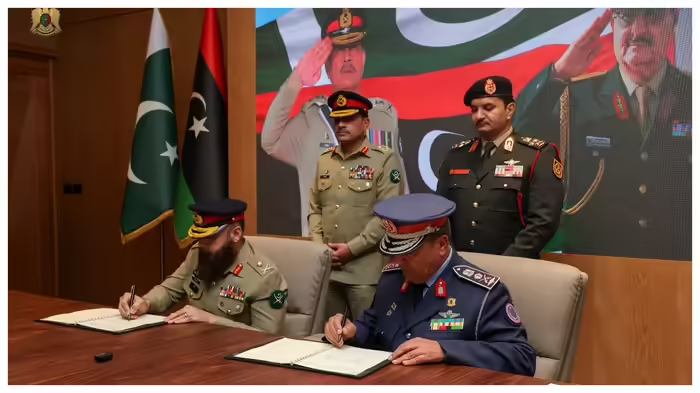
Islamabad/Tripoli: Pakistan has signed a major defense agreement with Libya, under which Islamabad will supply over $4 billion worth of military equipment to the Libyan National Army (LNA). According to four Pakistani officials cited by Reuters, this deal is one of the largest arms sales in Pakistan’s history.
The agreement was finalized last week in Benghazi, eastern Libya, during a meeting between Pakistan Army Chief Field Marshal Asim Munir and LNA Deputy Commander-in-Chief Khalifa Saddam Haftar.
JF-17 Fighter Jets and Military Hardware
Pakistani officials, who spoke on condition of anonymity, confirmed that the deal includes the sale of 16 JF-17 fighter jets, jointly developed by Pakistan and China. Additionally, Pakistan will provide 12 Super Mushshak trainer aircraft for basic pilot training. A senior Pakistani officer noted that the deal encompasses military equipment for land, sea, and air operations and will be completed over two to two-and-a-half years.
While estimates of the deal’s total value vary, officials indicate it ranges between $4 billion and $4.6 billion. The LNA’s official media confirmed the defense cooperation agreement, which includes arms sales, joint training, and military production. On Al-Hadath television, Haftar announced: “We are inaugurating a new phase of strategic military cooperation with Pakistan.”
UN Sanctions on Libya
Any arms agreement with the Libyan National Army may attract scrutiny, as Libya has been under UN sanctions since 2011. Approvals are required for weapons and related materials. It remains unclear whether Pakistan or Libya sought exemptions under these sanctions. However, three Pakistani officials emphasized that the deal does not violate any UN arms restrictions.
Officials also clarified that Pakistan is not alone in dealing with Libya. Haftar is currently under no international restrictions, and Benghazi authorities are reportedly seeking stronger ties with Western governments amid rising fuel exports.
Divided Libya
Since the NATO-backed overthrow of Muammar Gaddafi in 2011, Libya has remained politically unstable, split between two rival administrations. The Government of National Unity, led by Prime Minister Abdul Hamdi Dbeibah, controls much of western Libya, while Haftar’s LNA holds sway over the east and south.
Discover more from SD NEWS agency
Subscribe to get the latest posts sent to your email.