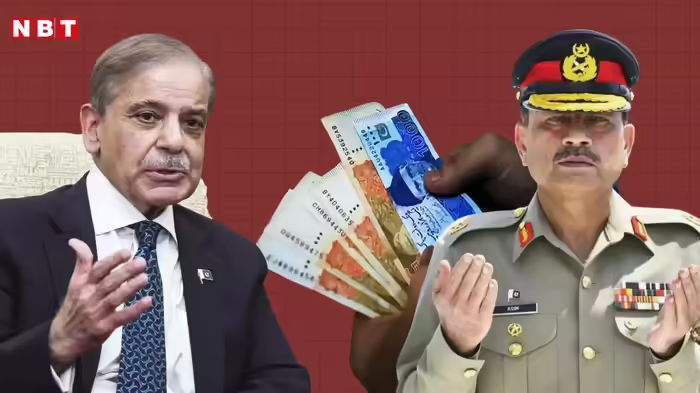
Islamabad: Pakistan has narrowly avoided default but remains trapped in a deepening economic crisis, where financial independence seems increasingly out of reach. Heavily reliant on loans to fund its expenses, the country is edging toward what analysts call “economic servitude.” While China remains Islamabad’s primary backer, its support can only partially ease financial pressures and cannot revive the faltering economy. Multinational companies are exiting the country, IMF programs impose strict conditions, and rising extremist violence has intensified the crisis.
Shehbaz Sharif Speaks on Debt
In a recently surfaced video, Prime Minister Shehbaz Sharif acknowledged the compromises Pakistan has made while borrowing from foreign countries. “I don’t know how to explain the manner in which we requested loans from friendly nations. They did not disappoint us, but anyone who goes to borrow money has their head bowed,” Sharif said. He added that he and Army Chief Asim Munir traveled to several countries seeking financial assistance, often fulfilling conditions they would have preferred to avoid.
Here are five key factors behind Pakistan’s worsening economic crisis:
1. A Debt-Driven Economy
Pakistan’s economy is largely running on borrowed money. Public debt has reached 70–80% of GDP, with repayments often refinanced through repeated borrowing and IMF programs. While loans temporarily ease financial strain, they come at the cost of national autonomy. Sharif’s admission underscores the compromises required when seeking foreign credit.
2. Declining Economic Growth
The Pakistani economy continues to struggle. The World Bank estimated a 3% growth for the fiscal year ending June 2025, with a similar pace expected in 2026. The IMF predicts a 3.2% growth rate for 2026. Analysts warn that this modest expansion is insufficient to address the country’s structural financial weaknesses.
3. Export Contraction
Pakistan’s exports have been steadily weakening. In 2024, exports accounted for only 10.4% of GDP, down from 16% in the 1990s. Trade deficits with neighboring countries have reached 44%, and the first half of the current fiscal year saw negative growth in trade with Bangladesh, Afghanistan, and Sri Lanka.
4. Exodus of Multinational Companies
Multinational companies are increasingly abandoning Pakistan. In October 2025, Procter & Gamble announced the closure of its operations in the country. Others leaving include Eli Lilly, Shell, Microsoft, Uber, Yamaha, and Telenor, with the pharmaceutical sector suffering the most. Of the 48 multinational firms previously operating in Pakistan, fewer than half remain today.
5. Rising Extremist Violence
Terrorist attacks in Pakistan surged by 34% in 2025. According to the Pakistan Institute for Peace Studies, there were 699 attacks, resulting in 1,034 deaths and 1,366 injuries, with over 42% of fatalities among security personnel and police. This violence has deterred investment, undermining Pakistan’s stability. Limited resources are increasingly diverted from development to security, adding a dual burden to the economy.
Discover more from SD NEWS agency
Subscribe to get the latest posts sent to your email.