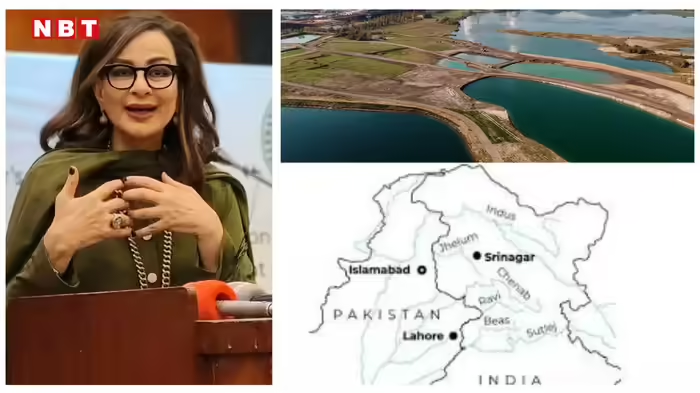
Islamabad: India’s approval of a new hydropower project on the Chenab River has sparked a strong reaction in Pakistan. Until recently, Islamabad viewed India’s previous threats to suspend the Indus Water Treaty (IWT) as largely symbolic. However, with India moving ahead on the Chenab project, Pakistani leaders have expressed serious concerns.
Senator Sherry Rehman stated on Monday, “Using water as a weapon is neither wise nor acceptable.” Her remarks came shortly after New Delhi granted clearance for the Dulhasti Stage-II Hydropower Project on the Chenab River.
Pakistan Peoples Party (PPP) leader Bilawal Bhutto Zardari criticized the move on social media, saying, “India has openly violated the Indus Water Treaty by approving the Dulhasti Stage-II project in Jammu and Kashmir. According to the IWT, Pakistan controls the waters of the Indus, Jhelum, and Chenab rivers, while Ravi, Beas, and Sutlej are under India’s jurisdiction. The treaty cannot be unilaterally revoked, as confirmed recently by UN experts.”
Senator Sherry Rehman further accused India of rapidly advancing several contentious hydroelectric projects in the Indus Basin after suspending the treaty, including Sukhlkot, Ratle, Bursar, Pakal Dul, Kwar, Kiru, and Kirathai-I & II, with Dulhasti Stage-II considered part of this strategic push. She added, “In a region already facing climate change and environmental stress, using water as a weapon is neither prudent nor acceptable. This will further strain bilateral relations already marred by distrust and hostility.”
Background: Indus Water Treaty
- India and Pakistan signed the treaty in 1960 under the mediation of the World Bank.
- The treaty divides the six rivers of the Indus Basin between the two countries.
- Pakistan has primary rights to the Indus, Jhelum, and Chenab, while India controls the Ravi, Beas, and Sutlej.
- India is allowed limited non-consumptive use of Pakistan-controlled rivers, such as run-of-the-river hydropower projects.
- India must share design and technical information with Pakistan before initiating any project.
- Despite wars in 1965, 1971, and 1999, the treaty has remained largely effective.
- After the Pahalgam terrorist attack, India had temporarily suspended the treaty.
India’s New Project on the Chenab
According to the Times of India, India’s Ministry of Environment approved a 260 MW hydropower project on the Chenab in Kishtwar district, Jammu & Kashmir. This approval comes just two months after the 1,856 MW Sukhlkot project was cleared on the same river. Both projects aim to maximize the river’s hydroelectric potential.
Reports from The Hindu note that with the IWT currently on hold, India is proceeding with multiple hydroelectric projects in the Indus Basin, including Sukhlkot, Ratle, Bursar, Pakal Dul, Kwar, Kiru, and Kirathai I & II. These developments follow the suspension of the treaty in response to Pakistan-backed terrorism in Pahalgam.