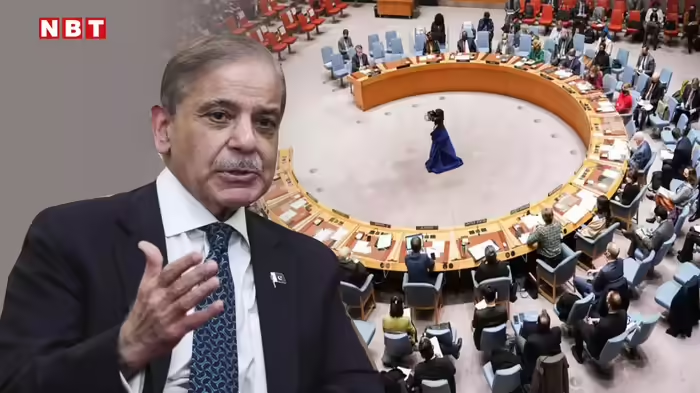
Alarmed by the growing international support for India’s bid for permanent membership of the United Nations Security Council (UNSC), Pakistan has launched a diplomatic offensive against New Delhi, opposing the extension of veto powers to any new member and raising objections over India’s decision to suspend the Indus Waters Treaty.
Speaking at the International Law Year in Review 2026 Conference on Thursday, Pakistan’s Permanent Representative to the United Nations, Asim Iftikhar Ahmad, argued that selective compliance with international treaties and uneven application of international law were undermining the foundations of the United Nations.
Without naming India directly, the Pakistani envoy criticised what he described as a “troubling trend” of disregarding binding international agreements, a reference widely seen as aimed at India’s suspension of the Indus Waters Treaty following the terrorist attack in Pahalgam, Kashmir, last year. India had announced the suspension on April 23, citing persistent cross-border terrorism.
Indus Waters Treaty at the Centre of Pakistan’s Complaint
Ahmad claimed that failure to honour binding international treaties posed a direct challenge to the UN system and threatened regional stability. He warned that unilateral actions on long-standing agreements such as the Indus Waters Treaty erode confidence in international law and increase instability in South Asia.
India, however, has consistently maintained that Pakistan’s continued support for terrorism undermines the spirit of cooperation on which the treaty is based.
Opposition to Veto Power for New Members
On UNSC reforms, Pakistan strongly opposed any expansion of permanent membership that includes granting veto power to new countries—a position widely interpreted as a direct attempt to block India’s entry into the Council as a permanent member.
The Pakistani envoy argued that reforms should not “worsen the inherent flaws” of permanent membership and the veto system. At the same time, he acknowledged that the United Nations continues to retain broad legitimacy as a global institution.
India’s Strong Case for Permanent Membership
India has long been at the forefront of calls for comprehensive reform of the UNSC, arguing that the current structure reflects post–World War II power equations and no longer represents today’s geopolitical realities.
Under Prime Minister Narendra Modi’s leadership, India has asserted that, as the world’s largest democracy and a major voice of the Global South, it deserves a permanent seat on the Council. India’s bid enjoys the backing of four of the five current permanent members— the United States, the United Kingdom, France, and Russia.
As momentum builds in favour of UNSC reform, Pakistan’s opposition highlights the deep diplomatic divide between the two South Asian neighbours and underscores the challenges facing consensus-driven changes to the world’s most powerful international body.
Discover more from SD NEWS agency
Subscribe to get the latest posts sent to your email.