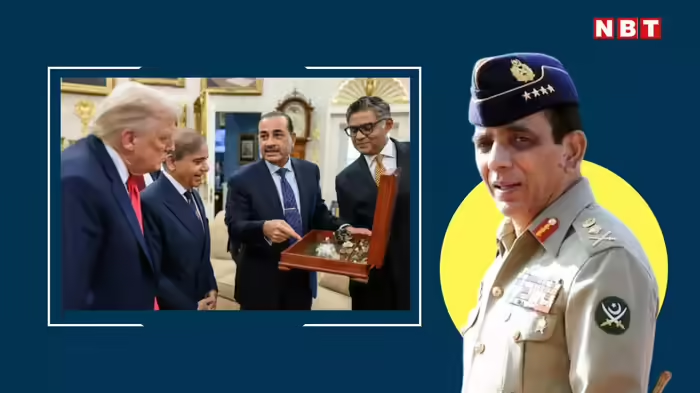
Despite repeated claims by Pakistan’s political and military leadership about its preparedness to confront India, a candid admission by a senior Pakistani journalist has exposed a starkly different reality. According to Pakistani journalist Haider Mehdi, Pakistan’s former Army Chief General Ashfaq Parvez Kayani had privately acknowledged that Pakistan cannot sustain a full-scale war with India for more than 15 days.
Mehdi made the disclosure during a conversation with former Pakistani military officer Adil Raja, stating that General Kayani had personally told him that Pakistan’s war doctrine was based on surviving for about two weeks before seeking international intervention.
“General Kayani told me clearly—no matter the circumstances, Pakistan cannot fight India beyond 15 days. At best, we can delay and stretch it to 20 days, but after that we must run to the United States, Russia, and other powers to stop the war,” Mehdi said.
India’s Military Strikes Exposed Pakistan’s Vulnerabilities
The remarks come in the backdrop of last year’s military escalation following the April 22 terrorist attack in Pahalgam. In response, India launched Operation Sindoor on the night of May 6–7, carrying out precision strikes on nine terrorist camps in Pakistan and Pakistan‑occupied Kashmir (PoK). Indian authorities assessed that over 100 terrorists were eliminated in the operation.
Subsequently, Pakistan attempted retaliatory strikes on Indian military and civilian targets, all of which were successfully neutralized by Indian air defenses.
According to U.S. intelligence assessments cited in international reports, India destroyed 11 Pakistani airbases, and the Pakistan Air Force lost nearly 20% of its assets during the conflict—an unprecedented setback.
Kayani’s Legacy and Controversy
General Ashfaq Parvez Kayani served as Pakistan’s Army Chief from 2007 to 2013 and remains one of the most controversial figures in the country’s military history. His tenure coincided with the 2011 U.S. operation that killed Osama bin Laden in Abbottabad, an incident that deeply embarrassed Pakistan’s armed forces.
Kayani has long faced allegations within Pakistan that he provided intelligence assistance to the United States in exchange for financial benefits. Critics claim he later relocated to Australia, where he currently resides, further fueling public resentment.
Pakistan’s War Doctrine: Delay, Then Diplomacy
Haider Mehdi revealed that Pakistan’s strategic planning was never focused on winning a prolonged war against India. Instead, the doctrine revolved around delaying Indian advances long enough to trigger external diplomatic pressure, primarily from Washington.
Adil Raja, reacting to Mehdi’s statement, remarked that Pakistan’s recent move to nominate former U.S. President Donald Trump for the Nobel Peace Prize fits this long-standing pattern of seeking American mediation during crises.
A Reality Check for Pakistan
The revelation has sparked intense debate within Pakistan, exposing the gap between official rhetoric and ground reality. Military analysts say the admission underscores India’s overwhelming conventional superiority, superior air power, and growing technological edge.
As regional tensions persist, Mehdi’s remarks serve as a rare and blunt acknowledgment from within Pakistan that, in a direct military confrontation, Islamabad’s endurance would be measured in days—not weeks.
Discover more from SD NEWS agency
Subscribe to get the latest posts sent to your email.