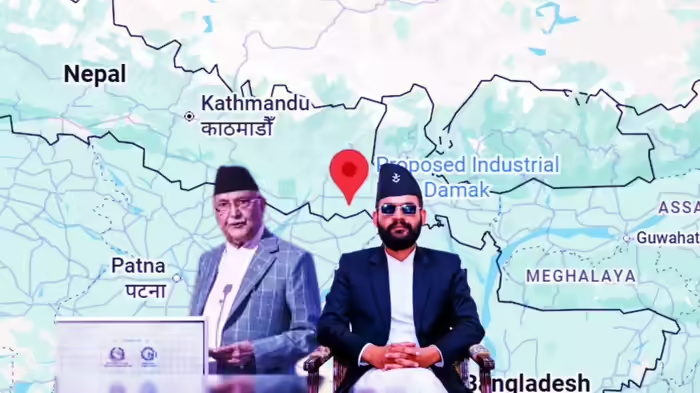
Kathmandu/Siliguri: In a major development ahead of Nepal’s national elections on March 5, Balen Shah, a key contender for the Prime Ministership, has effectively sidelined China’s ambitious Belt and Road Initiative (BRI) project from his election manifesto. The move has significant strategic implications for India, as the project lies near the Siliguri Corridor, also known as the “Chicken’s Neck,” which connects India’s northeastern states with the rest of the country.
China’s BRI Project Under Fire
The Nepal-China Friendship Industrial Park in Jhapa-5, envisioned as a multi-billion-dollar symbol of Nepal-China friendship, was initiated in February 2021 by former Prime Minister K.P. Sharma Oli as part of China’s BRI program. Balen Shah’s decision to exclude it from his manifesto directly challenges Oli’s ambitions, signaling growing China skepticism in Nepalese politics.
Oli had previously committed to completing the industrial park, along with nine other BRI projects, after signing a framework agreement during his December 2024 visit to Beijing. The park was designed to boost local industry, employment, and economic growth in Jhapa, a strategic region along Nepal’s eastern border.
Balen Shah: Nepal’s Rising Political Star
Balen Shah, a singer, rapper, and former Mayor of Kathmandu, leads the National Independent Party and is widely regarded as one of Nepal’s most prominent young leaders. His opposition to the industrial park has made Jhapa a focal point in both domestic and regional geopolitics.
The industrial park’s chairman, Govinda Thapa, alleged that foreign interference is delaying the project, subtly hinting at India, while emphasizing that the park’s purpose is economic, not military. Thapa claimed, “Balen Shah’s manifesto reflects a foreign-inspired agenda to block Chinese investment,” suggesting that India’s concerns may have indirectly influenced Shah’s policy.
Strategic Significance for India
The Jhapa industrial park is located close to India’s Siliguri Corridor, a narrow and strategically sensitive stretch connecting the northeastern states with mainland India. Any large-scale Chinese project here could raise serious security concerns for India. Two Nepali government officials confirmed to the Kathmandu Post that India has expressed reservations about the project and advised caution, underscoring the geopolitical sensitivity.
Former Nepalese Finance and Foreign Minister Prakash Sharan Mahat noted that following regional developments in Bangladesh and China’s growing influence, India is likely more vigilant. “We must consider India’s security concerns when approving projects along the border,” he said, highlighting the balancing act Nepal faces between foreign investment and regional stability.
Political and Diplomatic Implications
Balen Shah’s move to exclude the China-backed industrial park signals a potential shift toward India-friendly policies and a pushback against excessive Chinese influence in Nepal. As the election approaches, the decision has already sparked debate among political and strategic circles in Kathmandu, New Delhi, and Beijing, making it a defining issue of Nepal’s upcoming polls.
Discover more from SD NEWS agency
Subscribe to get the latest posts sent to your email.