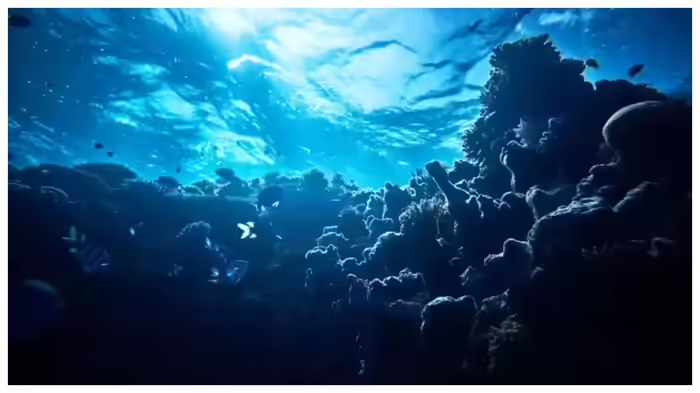
Tokyo: In a strategic move to end China’s dominance over rare earth minerals, Japan has announced plans to extract and refine these precious resources from the deep sea. According to Nikkei Asia, Japan aims to begin full-scale operations by 2027, targeting mineral-rich sediments located up to 6,000 meters below the ocean surface. The extracted seabed material will be transported to the mainland for processing. Japan is particularly focusing on minerals like dysprosium, which are vital for the automobile industry.
Japan is home to one of the world’s largest automotive sectors, with global brands such as Toyota, Honda, Suzuki, and Nissan. However, in 2010, a territorial dispute over the Senkaku Islands prompted China to halt rare earth mineral supplies, causing major disruptions for Japan’s industry. Since then, Japan has worked to diversify its supply chains and has successfully reduced its dependence on China by one-third.
A Direct Response to China
China currently controls nearly 70% of the global rare earth supply and accounts for about 90% of refining capacity. After the 2010 supply halt, Japan acquired a stake in Australian company Lynas, securing a long-term alternative source of rare minerals independent of China.
Japan’s latest plan involves harvesting rare earth minerals directly from its maritime territory. According to Nikkei Asia, a specialized facility will be established on Minamitorishima, one of Japan’s remote islands, to separate seabed sediments from water before transporting the material to the mainland for final refining. Test mining using research vessels is scheduled to begin in January–February 2026, with pipelines extracting the mineral-rich sludge from the ocean floor.
The Japanese government has allocated ¥16.4 billion (approximately $105 million) for this ambitious project, marking a major step toward securing domestic supply of critical minerals and reducing reliance on China’s global monopoly.
Discover more from SD NEWS agency
Subscribe to get the latest posts sent to your email.