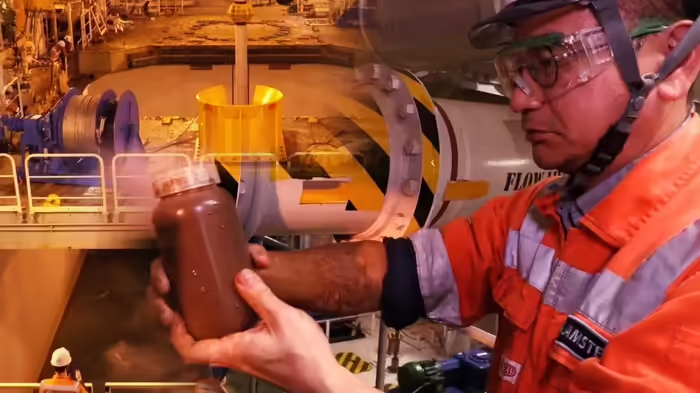
Tokyo: Japan has achieved a significant breakthrough in rare earth research, successfully drilling deep-sea sediments near Marcus Island (Minamitorishima) to extract rare minerals. Dubbed the “rare-earth rich mud” or “magical mud,” this discovery could help Japan reduce its reliance on China for critical minerals.
Successful Deep-Sea Extraction
Japanese Prime Minister Sanae Takaichi shared on X (formerly Twitter) that the research vessel Chikyu collected sediment from a depth of 6,000 meters (19,700 feet) near Minamitorishima. According to Takaichi, this marks the first-ever extraction of rare minerals from such depths. She called this a crucial first step toward domestic industrialization of rare minerals and emphasized Japan’s efforts to establish a strong supply chain, reducing dependence on any single country.
Operation Details
Officials from the Japan Agency for Marine-Earth Science and Technology said the Chikyu departed Tokyo on January 12 and reached Minamitorishima, 1,900 kilometers southeast of the capital. The recovery operation began on January 30, and by February 1, Innovative Ocean Development announced the successful extraction of rare-earth sediments from the seabed.
What the Mud Contains
Preliminary analysis indicates the sediment contains rare-earth elements such as dysprosium and neodymium, essential for high-performance magnets used in electric vehicle motors. It also contains gadolinium and terbium, used in electronics, medical imaging, and defense technologies. Samples of terbium and monazite have been sent to laboratories in Paris for further scientific study.
Next Steps
The extraction was carried out at three separate locations. After the vessel returns to Shimizu port on February 15, chemical and commercial analyses will be conducted. Officials stressed that further research is required to determine the total reserves and economic feasibility of commercial exploitation.
Plans for Large-Scale Mining
Japan has indicated that, barring major technical challenges, large-scale deep-sea mining trials could begin in February next year. If the extraction, separation, and refinement processes prove cost-effective, Japan could commence industrial-scale mining.
Currently, China dominates global rare-earth supply and has imposed several export restrictions on Japan. This successful extraction represents a major step toward reducing Japanese dependence on Chinese rare-earth resources, enhancing the country’s strategic independence and industrial capabilities.
Discover more from SD NEWS agency
Subscribe to get the latest posts sent to your email.