
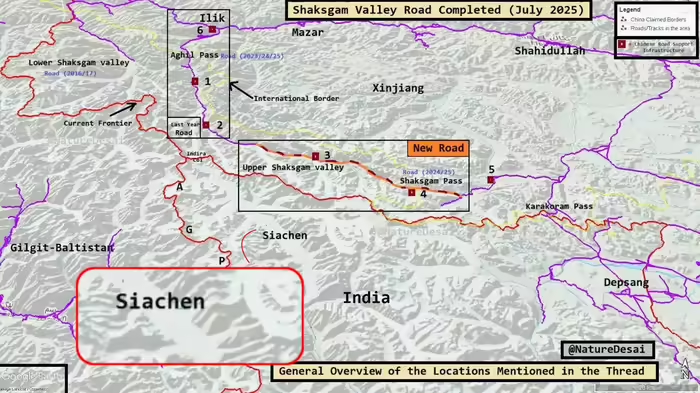
Beijing/New Delhi: China has once again sparked tensions with India over the Shaksgam Valley, a strategically crucial region in Jammu & Kashmir. On Monday, Chinese Foreign Ministry spokesperson Mao Ning rejected India’s claims over the valley, stating, “The area you mentioned belongs to China. Infrastructure development within our territory is completely legitimate.”
Satellite imagery and intelligence reports suggest that the People’s Liberation Army (PLA) is constructing a road in Shaksgam Valley at altitudes approaching 16,000 feet. This development comes shortly after India declared on 9 January that any Chinese infrastructure projects in the valley via the China-Pakistan Economic Corridor (CPEC) are “illegal and invalid,” reaffirming that Shaksgam Valley is an “integral and inalienable part” of India.
Strategic Geography of Shaksgam Valley
Shaksgam Valley is bordered by China’s Xinjiang province to the north, Pakistan-occupied Kashmir (PoJK) to the south and west, and the Siachen Glacier to the east. Situated in the northern Karakoram range, with an average elevation of 14,000–15,000 feet, the valley is not only geographically challenging but also strategically vital. The Shaksgam River, which flows into the Yarkand River, connects to the Tarim Basin, a critical area for China’s western frontier security.
For India, Shaksgam Valley’s proximity to the Siachen Glacier and the Saltoro Ridge makes any Chinese military infrastructure here a direct threat to the security of Indian positions in Siachen.
Why the Road Matters
The road under construction aims to link the Karakoram Highway with upper Shaksgam Valley. Intelligence reports indicate that if completed, it could extend to Aghil Pass (16,300 feet), bringing PLA forces closer to Siachen. Strategically, this road could provide China with an alternate logistic route to quickly transport heavy artillery, rocket systems, and other military hardware, potentially allowing pressure on Indian positions in Siachen from the north, while Pakistan already positions forces to the south and west. This scenario represents a potential “double-front threat” for the Indian Army.
Historical Context and Legal Concerns
Former Indian Foreign Secretary Kanwal Sibal highlighted on social media that under the 1963 China-Pakistan border agreement, China had recognized that Pakistan had no legitimate claim over Shaksgam Valley. “So how did it become Chinese territory when Pakistan transferred land it did not legally control? After the 1962 war, China saw an opportunity to assert control over this region,” he noted.
India maintains that the 1963 agreement is invalid under international law, as Pakistan had no sovereign rights over the area at that time. The valley, along with CPEC infrastructure, thus remains a point of contention. India has formally protested these developments with China multiple times over the past two years. However, after the 2020 Galwan conflict, India-China border talks have largely stalled, complicating the situation further.
Military Implications
While the terrain between Shaksgam Valley and Siachen is extremely rugged, featuring peaks over 6,500 meters, with few passable routes like Indira Col and Turkistan La, the Chinese could still threaten northern Siachen positions through long-range multi-rocket launchers (MRLS) and artillery, provided sufficient infrastructure is established in Shaksgam. This potential threat is a key concern for Indian defense planners.
Shaksgam Valley is not just a geographic region; it is a strategic flashpoint that could influence the security dynamics of Siachen Glacier, one of the most contested and militarily sensitive zones in the world. India continues to monitor developments closely while maintaining diplomatic protests to assert its territorial claims.
Discover more from SD NEWS agency
Subscribe to get the latest posts sent to your email.