Iran has witnessed one of its most intense waves of unrest in recent years, with mass protests erupting across the country earlier this month and continuing for nearly three weeks. Thousands of demonstrators took to the streets, openly demanding political change and challenging the authority of the Islamic Republic. While the protests have now been suppressed, they have triggered fresh debate over who truly holds power in Tehran.
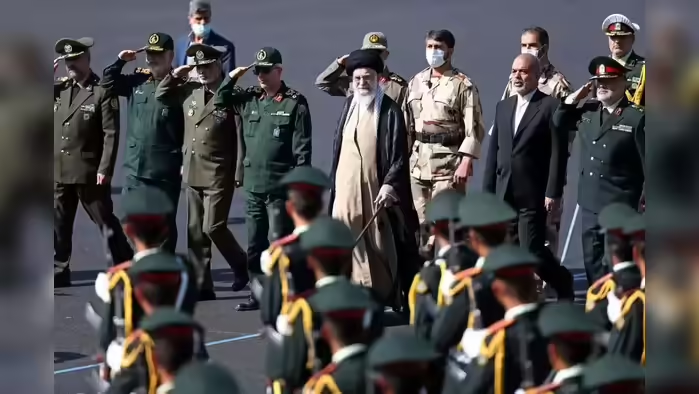
The demonstrations were eventually crushed by the state, but their aftermath has reshaped perceptions of Iran’s power structure. Although Supreme Leader Ayatollah Ali Khamenei remains the most visible symbol of authority, analysts argue that the Islamic Revolutionary Guard Corps (IRGC) has emerged as the decisive force behind the regime’s survival and future direction.
According to a report by Firstpost, Iran is undergoing a period of profound internal turbulence. Many political observers believe that real decision-making power no longer rests primarily with the clerical leadership but with the IRGC, which now dominates Iran’s security, political, and economic landscape.
Rise of the Revolutionary Guards
The IRGC was formed in 1979 following Iran’s Islamic Revolution as a specialized military force tasked with protecting the new regime. Over the decades, it has transformed into a sprawling institution with its own ground forces, navy, air divisions, and a powerful intelligence wing.
Former IRGC commanders now occupy senior positions in parliament, government ministries, key industries, and influential media organizations. This deep penetration has blurred the line between civilian governance and military authority, effectively centralizing power in the hands of the Guards.
Power Centralization in Tehran
While Iran’s president and cabinet retain administrative responsibilities, critics argue that strategic decisions—both domestic and foreign—are increasingly dictated by the IRGC. Detractors describe Iran’s elected institutions as being reduced to a symbolic role, while supporters view the Guards as a disciplined force capable of confronting internal unrest and external pressure simultaneously.
The recent protests were primarily triggered by economic hardship, rising inflation, and the impact of international sanctions. Ironically, these pressures have further strengthened the IRGC’s influence. Repeated nationwide demonstrations, driven largely by young Iranians, have not weakened the Guards; instead, they appear to have reinforced their grip on power.
Succession Uncertainty Looms
At the center of Iran’s political uncertainty is the question of succession. Ayatollah Ali Khamenei, now 90 years old, has not publicly named a clear successor. Analysts argue that this uncertainty has significantly enhanced the IRGC’s importance, as it is increasingly viewed as the only institution capable of maintaining continuity if clerical authority weakens.
The Guards’ dominance is further bolstered by their vast economic reach. Through conglomerates such as Khatam al-Anbiya, the IRGC controls large segments of Iran’s infrastructure, energy, and construction sectors. International sanctions, rather than curbing this influence, have often sidelined private competitors and strengthened IRGC-linked networks.
What Lies Ahead for Iran
As economic stress and public discontent continue to rise, questions about Iran’s future political structure are growing louder. Many analysts believe that the country’s trajectory will depend less on who occupies formal political offices and more on the entrenched power of the Revolutionary Guards.
Having firmly positioned itself as the backbone of the state, the IRGC is widely expected to play a decisive role in shaping Iran’s political and strategic future—raising the question of whether Iran’s supreme authority now lies more with the military than with the clerics.
Discover more from SD NEWS agency
Subscribe to get the latest posts sent to your email.