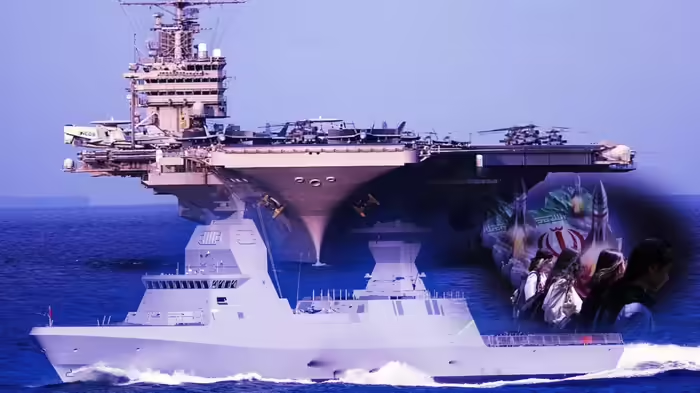
Tel Aviv: As tensions between Iran and the United States escalate toward a potential military confrontation, the arrival of the American aircraft carrier USS Abraham Lincoln in waters close to Iran has intensified regional anxieties. In the event of a U.S.-led strike on Iran, Israel is widely expected to play a supporting role, raising the possibility of Iranian retaliation against Israeli targets—particularly at sea.
Military analysts believe that Israeli naval vessels could be among Iran’s first targets in any counterattack. This has sparked an important question: Are Israeli warships capable of defending themselves against Iranian missile barrages in the same way as a U.S. carrier strike group?
USS Abraham Lincoln: A Floating Fortress
The USS Abraham Lincoln is not merely a warship—it is a floating airbase, displacing nearly 100,000 tons and operating under the protection of a full Carrier Strike Group. This group typically includes Aegis-equipped cruisers and destroyers that collectively create a multi-layered defensive shield spanning hundreds of kilometers.
Using the Aegis Combat System, U.S. naval vessels can detect, track, and intercept ballistic missiles, cruise missiles, drones, and aircraft long before they pose a direct threat to the carrier. The Abraham Lincoln never operates alone, relying instead on a networked, multi-ship air and missile defense architecture.
Israel’s Saar 6 Corvette: Small but Highly Advanced
In contrast, the Israeli Navy relies heavily on the Saar 6-class corvette, a compact yet technologically sophisticated warship with a displacement of around 1,900 tons. Though vastly smaller than an American aircraft carrier, the Saar 6 is designed specifically to counter threats from Iran and its regional proxies such as Hezbollah.
These warships were developed primarily to protect Israel’s offshore gas platforms and maritime infrastructure from missile and drone attacks.
C-Dome and Barak-8: Israel’s Naval Shield
The Saar 6 corvettes are equipped with the C-Dome, the naval variant of Israel’s Iron Dome system. C-Dome is capable of intercepting multiple incoming threats simultaneously, including rockets and short-range missiles.
Additionally, the ships are armed with the Barak-8 surface-to-air missile system, which has an interception range of approximately 70 to 100 kilometers. Barak-8 can neutralize cruise missiles, enemy aircraft, and UAVs, and is capable of engaging multiple targets at once, making it one of the most advanced naval air-defense systems in the region.
Powerful Radar Capabilities
A key strength of the Saar 6 is its MF-STAR radar, often compared to the U.S. Navy’s SPY-1 Aegis radar. This advanced digital radar can track hundreds of targets simultaneously, from sea-skimming missiles to high-altitude aircraft, and guide interceptors with remarkable precision.
Key Differences Remain
Despite their advanced systems, Israeli warships do not possess the depth, redundancy, or variety of defensive layers found in a U.S. carrier battle group. While the USS Abraham Lincoln benefits from coordinated defense across multiple ships and aircraft, Israeli corvettes operate with more limited support, making them potentially more vulnerable in the face of a large-scale Iranian missile assault.
Conclusion
While Israeli Saar 6-class corvettes are among the most advanced small warships in the world, capable of defending against sophisticated missile threats, they cannot replicate the overwhelming defensive umbrella of a U.S. aircraft carrier strike group. In the event of a full-scale conflict, Israeli warships could defend themselves against limited attacks—but a sustained or massive Iranian strike would pose a serious challenge.
Discover more from SD NEWS agency
Subscribe to get the latest posts sent to your email.