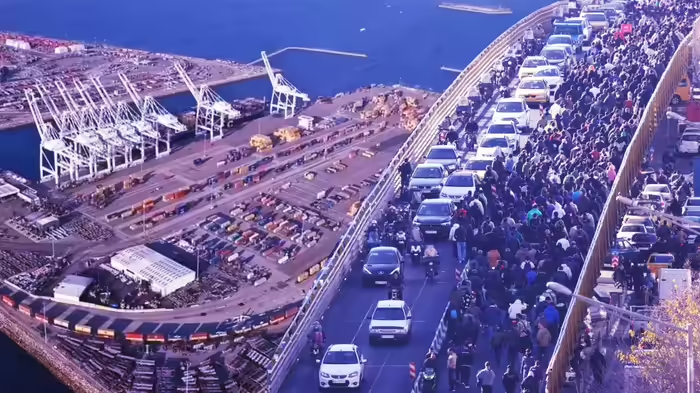
Widespread protests in Iran, initially sparked by currency depreciation and rising inflation, have now spread across more than 100 cities and several towns. The unrest, which began two weeks ago, is escalating political instability and has caught India’s attention, particularly due to its potential impact on Chabahar Port, a cornerstone of India’s strategic and economic presence in the region.
Protests Trigger Strategic Uncertainty
Tehran and other major cities have seen mass demonstrations demanding government accountability. According to top intelligence sources cited by CNN-News18, escalating violence and unrest have cast uncertainty over India’s long-term investments at Chabahar. The port, which India has invested $500 million in, is critical not only as an economic gateway but also as a counterbalance to China-Pakistan influence in the region.
Disruption of Supply Chains
Strikes, internet shutdowns, and mass protests have already begun to affect Iran’s supply chains, potentially delaying cargo handling and infrastructure development at Chabahar. The port serves as a vital economic corridor, bypassing Pakistan to connect India with Afghanistan, Central Asia, Russia, and Europe.
A Strategic Hub for India
Chabahar is central to India’s “Connect Central Asia” policy, aimed at strengthening trade ties with Uzbekistan, Kazakhstan, and Turkmenistan. It forms a key segment of the International North-South Transport Corridor (INSTC), a 7,200-kilometer multi-modal network linking India to Iran, the Caspian Sea, Russia, and Europe. Compared to the traditional Suez Canal route, the INSTC reduces transit time by 40% and shipping costs by 30%, saving 25-30 days on transport. Prolonged unrest in Iran could jeopardize these advantages, causing substantial economic losses for India.
Rail Connectivity at Risk
The Chabahar-Zahedan railway project, integral to INSTC integration, is also under threat. Strikes, funding delays, or prolonged demonstrations could disrupt rail connectivity. Reports indicate that even lower-ranking officers of Iran’s Islamic Revolutionary Guard Corps (IRGC) are affected by the economic crisis, potentially impacting worker morale and security at the port.
China and Pakistan Eye Strategic Opportunity
India is also concerned that instability in Chabahar could create a strategic vacuum exploitable by China. The port counters Chinese influence at Gwadar, a key hub in the Belt and Road Initiative (BRI), while Pakistan prefers to limit India’s presence. Beyond economics, Chabahar allows India to monitor Chinese naval and commercial activities in the Arabian and Indian Oceans. Any disruption here could have far-reaching strategic consequences.
With unrest spreading to Chabahar, India is closely monitoring developments, aware that stability in Iran is critical not just for trade but for long-term regional influence.
Discover more from SD NEWS agency
Subscribe to get the latest posts sent to your email.