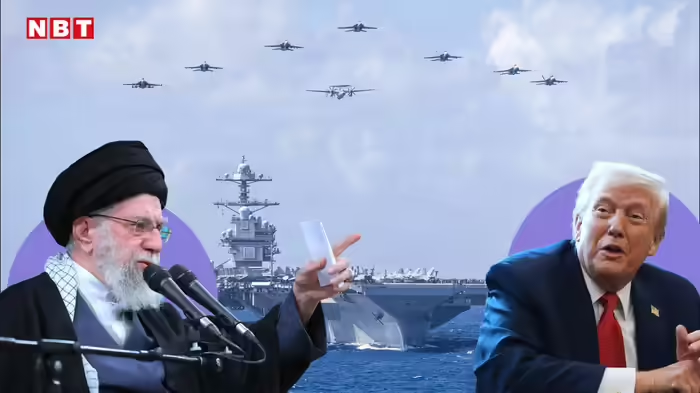
Tehran/Washington: Tensions between the United States and Iran have escalated sharply after U.S. President Donald Trump issued what he described as a final ultimatum to Tehran over its nuclear program, warning of a “very bad” military response if Iran refuses to return to the negotiating table.
The warning comes amid a significant U.S. military buildup in the Middle East. The aircraft carrier USS Abraham Lincoln, accompanied by three destroyers—USS Frank E. Petersen Jr., USS Spruance, and USS Michael Murphy—has arrived in the region. Together, the strike group represents formidable firepower, including Tomahawk land-attack cruise missiles and reportedly a nuclear-powered submarine.
In a series of posts on social media, Trump said he hoped Iran would “quickly come to the negotiating table and make a fair and proper deal—no nuclear weapons.” He added that time was “running out fast” for Tehran and made it clear that Iran “cannot have nuclear weapons under any circumstances.”
Iran Responds with Strong Warnings
Iran reacted sharply to Trump’s threats. Ali Shamkhani, senior adviser to Supreme Leader Ayatollah Ali Khamenei, warned on X that any U.S. military action would result in Iran targeting the United States, Israel, and their allies.
Foreign Minister Abbas Araghchi echoed the warning, stating that Iran’s armed forces are “fully prepared for an immediate and powerful response” to any attack, with their “fingers on the trigger.”
At the same time, Araghchi said Iran remains open to a “mutually beneficial, fair, and equal nuclear agreement”—but only one that guarantees Iran’s right to peaceful nuclear technology and is free from coercion, threats, and intimidation.
Questions Over Trump’s Shifting Narrative
Trump has repeatedly referred to U.S. and Israeli strikes carried out in June 2025, claiming at the time that Iran’s nuclear program had been “destroyed.” However, geopolitical analyst Stanly Johny has questioned the consistency of Trump’s position.
“If Iran’s nuclear program was eliminated in June 2025, why is Washington demanding a nuclear deal again in January 2026?” Johny wrote, arguing that nuclear concerns—not democracy or human rights—remain the core issue.
Iran had previously denied the International Atomic Energy Agency (IAEA) access to bombed sites, fueling further uncertainty over the actual state of its nuclear capabilities.
No Signs of Diplomacy—for Now
Iranian state media reported that Araghchi has had no recent contact with U.S. Special Envoy Steve Witkoff, nor has Tehran requested talks. While backchannel diplomacy cannot be ruled out, there are no visible public signs of negotiations underway.
With both sides hardening their positions and U.S. naval forces moving closer to Iran, fears are growing that the standoff could spiral into a direct military confrontation.
Discover more from SD NEWS agency
Subscribe to get the latest posts sent to your email.