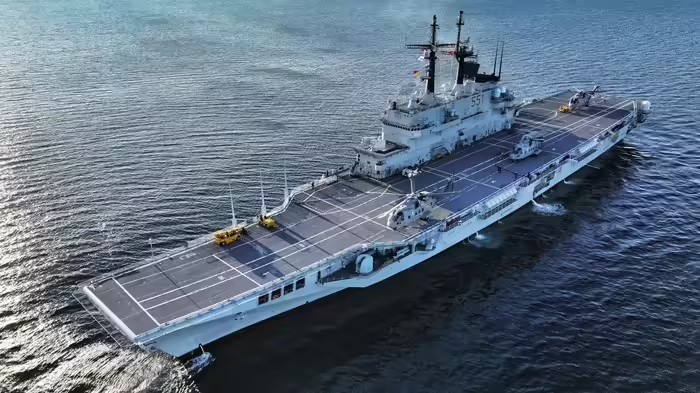
Jakarta: Indonesia is set to become the second country in Southeast Asia and the fifth in Asia to operate an aircraft carrier, following Thailand, China, India, and Japan. The Indonesian Navy will acquire the Giuseppe Garibaldi aircraft carrier from Italy on a grant basis, a vessel that served the Italian Navy from 1985 to 2024. Delivery is expected in October this year.
Strategic Significance
The acquisition is part of President Prabowo Subianto’s vision to modernize Indonesia’s armed forces. Analysts say the carrier will enhance the Navy’s ability to conduct both combat and non-combat operations, including intelligence, surveillance, and reconnaissance missions. The 180-meter-long ship can operate helicopters, jets, and propeller aircraft, and can also be modified to deploy drones to curb illegal fishing, smuggling, and incursions into maritime borders and economic zones.
Humanitarian and Disaster Relief Role
The Indonesian Navy Chief of Staff, Admiral Mohammad Ali, emphasized that the carrier will primarily support humanitarian missions. With an operational range of 13,000 nautical kilometers, it can deliver aid across Indonesia’s vast archipelago, stretching over 5,000 km east to west and 1,700 km north to south.
However, Abdul Rahman Yakub, a researcher at the Rabdan Security & Defence Institute in Abu Dhabi, cautioned that aircraft carriers are not ideal for disaster relief, which requires speed, flexibility, shallow-water access, and the ability to deliver medical aid and supplies directly to affected areas.
Regional Implications
While the carrier is officially aimed at humanitarian and modernization goals, analysts warn neighboring countries may perceive it as a strategic military asset. Yakub said, “In a region already sensitive to naval modernization and power dynamics, such acquisitions are inevitably viewed through a military lens.”
Still, some experts, like Khairul Fahmi of the Institute for Security & Strategic Studies (ISESS), believe the Garibaldi’s age—nearly 40 years—and limited capacity compared to modern carriers means it is unlikely to trigger a regional arms race or destabilize Southeast Asia. The vessel cannot accommodate the latest-generation fighter jets, which limits its combat capability.
Cost and Operational Considerations
Operating the carrier is expected to cost between $50 million and $80 million annually, not including the extensive time required to train crew members. Despite these challenges, Indonesia’s move underscores its ambition to strengthen naval power and enhance regional influence while maintaining a focus on humanitarian missions.
Discover more from SD NEWS agency
Subscribe to get the latest posts sent to your email.