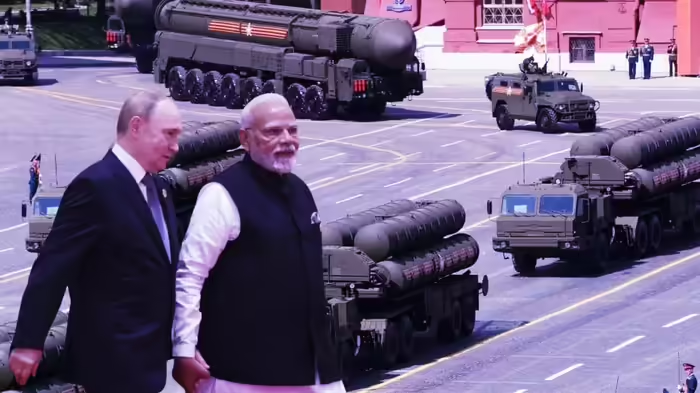
Moscow/New Delhi: India has long depended on Russia for defence procurement, ranging from fighter jets to air defence systems. While efforts in recent years have diversified India’s arsenal, particularly in fighter aircraft and conventional weapons, the country remains heavily reliant on Russia for air defence. India’s trust in the Russian S-400 Triumf air and missile defence system has been particularly prominent, with the system performing effectively against aerial threats during last year’s four-day India-Pakistan skirmish.
Despite operational success, British defence analysts caution that over-reliance on the S-400 may pose strategic risks.
India’s S-400 Deal and Deployment
According to The Wire, India signed a deal with Russia in 2018 to procure the Almaz-Antey “Triumf” S-400 integrated air and missile defence system. By mid-2023, India had deployed three of the five S-400 regiments purchased for $5.5 billion. Following Operation Sindoor, India entered negotiations with Russia to acquire at least five additional S-400 or advanced S-500 systems.
Operational Success and Emerging Challenges
India’s three S-400 units were instrumental in countering aerial threats during the India-Pakistan confrontation. Russia has also deployed the system in its ongoing conflict with Ukraine. However, analysts at the London-based Royal United Services Institute (RUSI) highlight multiple challenges in expanding India’s S-400 capabilities.
Dependence on China for Maintenance and Supplies
Experts point out that Russia’s ability to produce, maintain, and upgrade the S-400 is increasingly reliant on China. This includes interceptor replenishment, radar repairs, software updates, and supply chain prioritization. Such dependence poses a strategic challenge for India.
Impact of the Russia-Ukraine War
RUSI analyst Dr. Jack Watling notes that Russia’s prolonged engagement in the Ukraine war has put significant pressure on the production and upkeep of the S-400 system. The system itself depends heavily on foreign microelectronics, imported raw materials, and software designed abroad. Restrictions on Russian military entities and limited access to external suppliers have caused delays, including indefinite postponement of the delivery of the remaining two S-400 systems to India, affecting India’s air defence planning.
China’s Role and Strategic Dilemma for India
Watling emphasizes that Russian dependence on China has created a strategic paradox for India. A senior defence industry official in New Delhi warns that China’s involvement could compromise India’s wartime resilience and operational autonomy. Expanding India’s S-400 inventory without addressing these vulnerabilities could further impact system availability, upgrade cycles, and long-term maintenance.
Longstanding India-Russia Defence Ties under Pressure
India and Russia share over six decades of defence cooperation, with Russian fighter jets, transport aircraft, helicopters, warships, submarines, tanks, missiles, and air defence systems forming the backbone of the Indian armed forces. While Russia has historically supplied India with sensitive technology unavailable from Western countries, emerging operational and logistical challenges are testing this longstanding partnership. Analysts also note that these challenges extend beyond the S-400 to other defence systems.
Conclusion: A Strategic Gamble
British defence experts conclude that India’s reliance on the Russian S-400 presents a difficult strategic scenario. While the system has proven effective against regional threats, the combination of supply chain dependencies, production pressures, and escalating tensions with Pakistan makes it a high-stakes gamble for India’s defence planners.
Discover more from SD NEWS agency
Subscribe to get the latest posts sent to your email.